

A compromised iPhone is now a privileged cloud endpoint. This isn't a theoretical risk; it's the operational reality created by the emergence of iOS exploit kits like Coruna. These tools, once the exclusive domain of nation-states, are now being used in broader criminal campaigns, turning your team's mobile devices into backdoors to your production environment.
The Google Threat Intelligence Group (GTIG) identified Coruna (also known as CryptoWaters) targeting a wide range of devices. Specifically, the kit is effective against iPhones running iOS versions 13 through 17.2.1. The threat isn't just data theft from the phone; it's the theft of standing cloud access credentials that enable direct attacks on your infrastructure.
Your team’s reliance on mobile devices for work, including developers and SREs with high-level permissions, creates a direct path for attackers. When an exploit kit achieves kernel-level access on a phone, it bypasses MFA and other identity controls. The real challenge isn't just detecting the malware; it's severing the connection between the compromised device and your cloud resources before lateral movement occurs.
Deconstruct the Mobile-to-Cloud Kill Chain
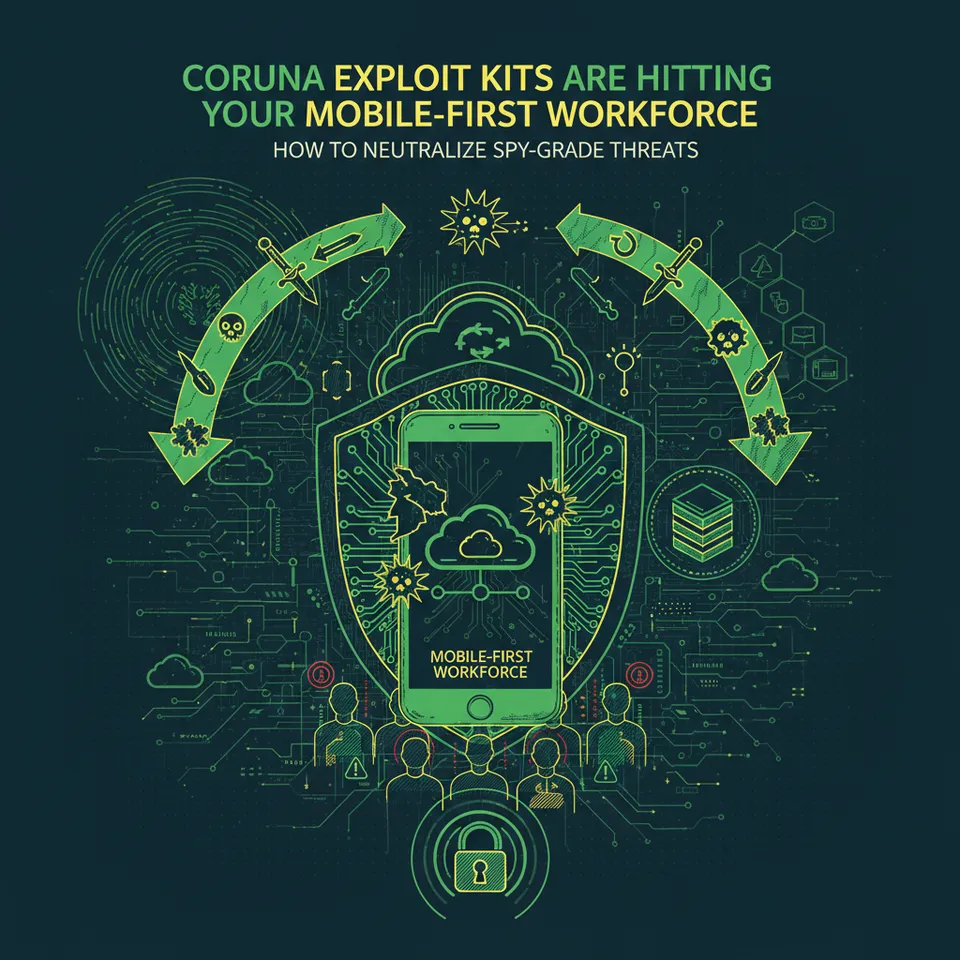
Understanding the attack path is the first step toward building an effective defense. The Coruna kill chain doesn't end on the mobile device. It uses the phone as a pivot point to gain authenticated access to high-value cloud targets. This is the new frontier of mobile to cloud lateral movement.
Stage 1: Initial Compromise via Sophisticated Exploit Chains
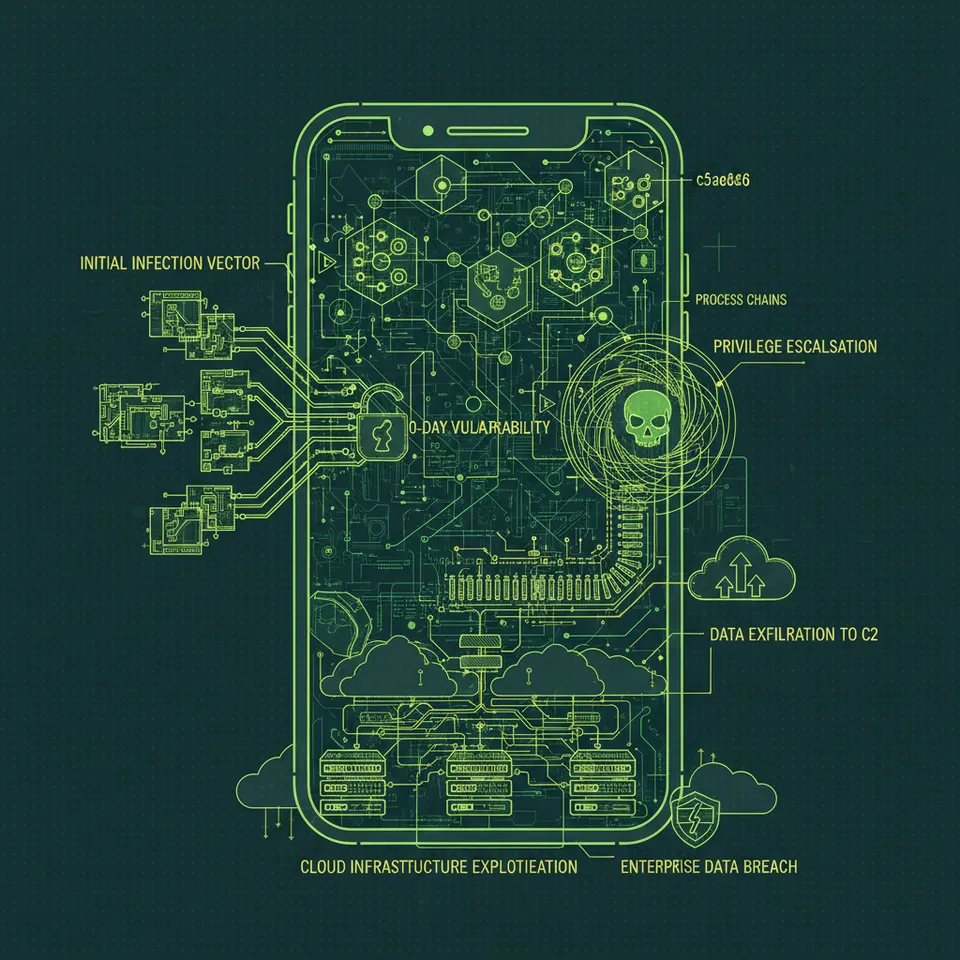
The initial infection doesn't rely on user error. The Coruna exploit kit packages 23 different exploits into five distinct chains, targeting vulnerabilities in iOS components like the kernel and WebKit. These are often zero-click or one-click exploits delivered through iMessage or a malicious webpage, meaning the user may have no idea their device has been compromised.
These exploits are designed for stealth and persistence, operating with kernel-level privileges that make them invisible to most security software running on the device. An attacker's goal here's to establish a covert foothold to begin the next stage of the attack: credential harvesting.
Stage 2: Session Token and Credential Extraction
Once the device is compromised, the primary objective is to steal session tokens, not passwords. Attackers target the memory of applications used for work, such as the AWS Console mobile app, Microsoft Authenticator, or corporate SSO apps. With kernel-level access, the malware can read memory that's normally protected, extracting active session cookies, OAuth refresh tokens, and API keys.
These tokens are immensely valuable. They represent an authenticated session and allow an attacker to bypass MFA and password-based defenses entirely. The attacker doesn't need to phish for credentials when they can simply steal the active session of a privileged user like a cloud administrator or a senior developer.
Stage 3: Cloud Impersonation and Lateral Movement
With stolen session tokens, the attacker can now impersonate the legitimate user from anywhere in the world. They can use the stolen token to make authenticated API calls to AWS, Azure, or GCP, effectively operating as that user. Since the session is valid, it often won't trigger standard security alerts like impossible travel if the attacker is careful to use proxies.
From here, the attacker can explore the cloud environment, escalate privileges, exfiltrate data, or deploy ransomware. They can access source code repositories, CI/CD pipelines, and production databases. The initial mobile compromise has successfully been converted into a full-blown cloud breach, all without a single alert from your network-based security tools.
Your CSPM Is Only Seeing the Aftermath
Cloud Security Posture Management (CSPM) tools like Wiz, Prisma Cloud, or Orca are excellent at finding misconfigurations and vulnerabilities within your cloud estate. They’ll tell you an IAM role is overly permissive or that a security group is wide open. They won't, however, tell you that the identity currently using that IAM role is doing so from a compromised iPhone.
This creates a critical detection and remediation gap. Your SOC might get an alert about anomalous activity from a user account, but they lack the context to know the root cause is a mobile device exploit. This disconnect means response efforts are focused on the cloud account (changing a password, rotating keys) while the attacker retains their foothold on the mobile device, ready to steal the new credentials.
This gap is a primary driver of alert fatigue and slow Mean Time to Remediate (MTTR). Without connecting the endpoint's health to the cloud identity's permissions, security teams are simply chasing symptoms. The key to an effective defense is to bridge this gap and tie cloud security remediation directly to the state of the accessing device.
Build an Automated Session Revocation Playbook
Responding to a threat like Coruna requires speed and precision. A manual response is too slow; by the time a human can investigate and act, the attacker has already achieved their objectives. An automated playbook for session revocation is essential to neutralize this threat in near real-time.
Step 1: Define Your Trigger with High-Fidelity Context
A low-fidelity trigger like "device is jailbroken" is too noisy and often inaccurate for modern exploits. A high-fidelity trigger combines data from multiple sources. For example: A device running a known vulnerable iOS version (e.g., 17.2.0) belonging to a user in the 'AWS-Admins' group has just authenticated to the AWS Console.
This trigger is specific, contextual, and actionable. It focuses on the highest-risk scenario: a privileged user on a vulnerable device. This allows you to build targeted automation without disrupting the entire organization. The U.S. CISA's Known Exploited Vulnerabilities (KEV) catalog is a critical source for defining these vulnerable versions, especially after exploits like those used by Coruna are added.
Step 2: Isolate the Identity, Not the Device
Your first move shouldn't be to remotely wipe the phone. That's a destructive action that can impede investigation and cause significant user friction. The immediate goal is to contain the blast radius by isolating the *identity*.
Use your Identity Provider's (IdP) APIs to programmatically take action. For example, in Azure AD (Entra ID), you can move the user to a special group governed by a strict Conditional Access policy that blocks access to all sensitive applications. In Okta, you can suspend the user or clear all sessions. This allows the user to still access low-risk applications like email to communicate with IT while preventing access to cloud consoles and production systems.
Step 3: Execute Cross-Cloud Session Termination Scripts
Changing a password or suspending an account doesn't always invalidate active session tokens. You must explicitly revoke them. This is a complex, multi-step process that needs to be scripted for every major cloud provider your organization uses. The complexity of this step is why many teams struggle and where automated remediation playbooks are critical.
Here’s a conceptual look at the commands needed:
# For AWS, invalidate sessions for an IAM role assumed by the user
aws iam put-role-policy --role-name Your-Admin-Role --policy-name Session-Revoke-Policy --policy-document file://deny-old-sessions.json # For Azure AD, revoke all refresh tokens for a user
Revoke-AzureADUserAllRefreshToken -ObjectId "user@yourdomain.com" # For Google Cloud, revoke the user's credentials
gcloud auth revoke user@yourdomain.com
An effective remediation platform orchestrates these commands across all clouds simultaneously as soon as the trigger is met. This ensures all active sessions are terminated, effectively locking the attacker out of your environment. This is the core of an effective automated session revocation strategy.
Implement Technical Controls to Minimize the Blast Radius
While automated response is crucial, proactive controls can significantly reduce the potential impact of a compromise from the outset. These controls are designed to shrink the window of opportunity for an attacker.
Enforce Short-Lived, Just-in-Time Sessions
Long-lived sessions are a gift to attackers. A 12-hour session token means a device compromised in the morning gives an attacker a full business day of access. Drastically reduce session lifetimes for privileged roles. For highly sensitive access, like a production AWS console, enforce a 1-hour session timeout that requires re-authentication with MFA.
This principle of least privilege extends to time. It frustrates attackers by forcing them to constantly re-establish access, which increases their chances of being detected. It also limits the value of any single stolen token.
Use Device Trust and Conditional Access Policies
Integrate your MDM/UEM solution with your IdP to create device-aware access policies. These policies can enforce that only compliant devices are allowed to access sensitive applications. A compliant device is one that's running the latest OS, is not jailbroken, and has all required security software active.
For example, you can create a policy in Azure AD Conditional Access that states: IF user is in 'Cloud Admins' group AND is accessing 'AWS Console' app AND device.isCompliant = FALSE THEN BLOCK access. While not foolproof against kernel-level exploits, this forces attackers to bypass another layer of defense and raises the bar for a successful attack. For older devices that can't be patched, Apple's Lockdown Mode can be an effective mitigation.
Automate Vulnerability-Based Access Control
Don't wait for your annual patch cycle to address critical mobile vulnerabilities. Your security posture should adapt ally based on new threats. When CISA adds an iOS CVE to its KEV catalog, an automated workflow should immediately fire.
This workflow can query your device management tool for all devices running the vulnerable version. It can then cross-reference that list with your IdP to identify which of those users have privileged access. Those users should have their access temporarily restricted until their device is patched. This proactive stance helps you drastically shrink your vulnerability MTTR by turning threat intelligence into immediate, protective action.
The commoditization of spy-grade threats like the Coruna exploit kit means mobile devices can no longer be treated as trusted endpoints. The focus must shift from simply detecting threats to implementing automated, production-safe remediation that severs the attack path between the mobile device and the cloud. Effective security isn't about having the most alerts; it's about having the fastest, most reliable fixes.
Instead of drowning in disconnected alerts, focus on building automated responses that connect endpoint state to cloud entitlements. Take a look at how Tamnoon's platform helps operationalize these complex remediation playbooks.

Tamnoon helps security teams remediate cloud risks faster with AI-augmented managed services — combining human expertise with automation so nothing falls through the cracks.
Learn more at tamnoon.ioFAQs
What specifically is the Coruna iOS exploit kit and why is it a big deal now?
The Coruna exploit kit is a suite of software tools designed to exploit vulnerabilities in Apple's iOS. Its significance stems from its origin as a likely derivative of spy-grade surveillance technology, such as that used in 'Operation Triangulation.' Its recent appearance in broader criminal circles represents the commoditization of nation-state-level attack capabilities. This lowers the barrier to entry, enabling less sophisticated actors to target enterprise executives, developers, and other high-value individuals who have privileged access to corporate cloud environments.
How does an iOS compromise technically lead to a cloud data breach?
An iOS compromise grants an attacker kernel-level access, allowing them to bypass the operating system's normal security boundaries. The malware can then perform memory scraping on applications like the AWS Console or Okta Verify. This allows it to extract active OAuth2 refresh tokens and session cookies. These tokens are bearer tokens, meaning whoever possesses them can use them to impersonate the user. The attacker replays these stolen tokens from their own infrastructure to gain authenticated access to cloud APIs, effectively bypassing MFA and password requirements.
Why can't standard MDM or EDR solutions stop the Coruna exploit kit?
Standard MDM and EDR tools operate within the user space of the OS and have limited visibility into the kernel. Coruna uses advanced, in-memory exploits that often leave minimal on-disk artifacts for these tools to find. It doesn't typically perform a traditional 'jailbreak' that an MDM might detect. Instead, it exploits vulnerabilities to gain temporary root access and inject its payload directly into memory. This kernel-level foothold makes it functionally invisible to security solutions that lack the deep system-level inspection capabilities required to detect such threats.
What are the most critical CVEs used by this type of iOS attack?
Coruna leverages a chain of vulnerabilities to succeed. For example, it might start with a WebKit flaw like CVE-2023-41974 to gain initial code execution when a user visits a webpage. It then uses a second exploit, such as the kernel vulnerability CVE-2023-43000, to escalate privileges and take full control of the device. The U.S. Cybersecurity and Infrastructure Security Agency (CISA) added these to its Known Exploited Vulnerabilities (KEV) catalog. A proper defense requires not just patching but also having a rapid response plan for when a device is found running a vulnerable version.
How does an automated remediation platform's approach differ from just using a vulnerability scanner?
A vulnerability scanner, like those in a CSPM, identifies the 'what'—for example, 'this iOS version is vulnerable.' An automated remediation platform answers the 'so what' and 'now what.' It connects that vulnerability to the user's identity and their cloud permissions. Instead of just generating an alert, it triggers a pre-defined playbook. This playbook can automatically isolate the user's cloud identity, execute API calls to revoke all active sessions across AWS, Azure, and GCP, and restrict access until the device is remediated, preventing mobile-to-cloud lateral movement.