

An untagged cloud asset is a security incident waiting for a victim. Without clear ownership metadata, the thousands of alerts from your CNAPP or CSPM are just noise, delaying remediation and leaving critical exposures open for hours or days. This ambiguity is the primary bottleneck that halts incident response before it can even begin.
When a tool like Wiz, Prisma Cloud, or Orca flags a publicly exposed S3 bucket or a virtual machine with a critical vulnerability, the first question is always “Who owns this?” If the answer isn't immediately available via a tag, security teams are forced into a manual, time-consuming investigation. This chase directly inflates Mean Time to Remediate (MTTR), increases risk, and burns out security personnel who spend more time acting as detectives than engineers. A well-defined tagging strategy isn't about tidiness; it's a non-negotiable prerequisite for scalable cloud security operations.
Building an effective tagging policy isn't a theoretical exercise. It's about creating a concrete schema that serves three critical functions: security, operations, and finance. This schema acts as the universal language that connects a resource to its purpose, its owner, and its risk profile, enabling automated workflows that are otherwise impossible. It's the foundation for fixing problems instead of just finding them.
Define Your Mandatory Tag Schema
A tagging policy starts with a defined set of mandatory tags. These aren't suggestions; they're required key-value pairs that must be present on every provisioned resource. A good starting point is to categorize these tags by their function.
- Security & Compliance Tags: These provide immediate context for risk assessment.
Owner_Emailis the single most important tag for remediation, as it directly identifies the point of contact. Other critical tags includeData_Classification(e.g., Public, Internal, Confidential, Restricted) andCompliance_Scope(e.g., PCI, HIPAA, GDPR), which help prioritize alerts based on data sensitivity and regulatory requirements. - Operational Tags: These connect assets to services and their lifecycle stage. Mandatory tags like
ProjectorApplicationIDlink the resource to a specific business application. TheEnvironmenttag (e.g., Prod, Staging, Dev) is essential for assessing the blast radius of a potential incident and applying environment-specific remediation rules. - Financial Tags: While primarily for FinOps, tags like
CostCenterorTeamare also valuable security indicators. They often map directly to a business unit and its leadership, providing an additional escalation path when an owner is unresponsive.
This schema should be documented in a central, accessible location like a company wiki, becoming the “Tagging Dictionary.” It should define each key, its purpose, and the acceptable value formats (e.g., free-form string, enumerated list, email format). This documentation is crucial for ensuring consistency across hundreds of development teams.
Implement and Enforce Tagging with IaC

A policy is ineffective without enforcement. The most effective way to ensure tag compliance is to build it directly into your provisioning pipeline using Infrastructure as Code (IaC) and cloud-native policy engines. This approach prevents untagged or non-compliant resources from ever being created.
Use Policy-as-Code for Proactive Enforcement
Catching tagging errors before deployment is far more efficient than cleaning them up later. Modern cloud environments should use policy-as-code to enforce the tagging schema at the source.
In AWS, you can use IAM policies to deny resource creation if mandatory tags are missing. This policy statement, for example, prevents anyone from launching an EC2 instance without the Project and Owner_Email tags. It effectively makes tagging a prerequisite for provisioning.
{ "Version": "2012-10-17", "Statement": [ { "Sid": "EnforceMandatoryTagsForEC2", "Effect": "Deny", "Action": "ec2:RunInstances", "Resource": "arn:aws:ec2:*:*:instance/*", "Condition": { "Null": { "aws:RequestTag/Project": "true", "aws:RequestTag/Owner_Email": "true" } } } ]
}
In Azure, Azure Policy is the primary tool for enforcement. You can create a policy definition that audits for or denies the creation of resources that lack required tags. This JSON snippet defines a policy that will deny any resource creation if the CostCenter tag is not present.
{ "mode": "Indexed", "policyRule": { "if": { "field": "tags['CostCenter']", "exists": "false" }, "then": { "effect": "deny" } }
}
In GCP, you can use Organization Policies to enforce label requirements (GCP’s equivalent of tags). This approach ensures that all resources within a project or folder adhere to the defined labeling schema, maintaining consistency across the organization.
Embed Tags Directly in Terraform
For teams using IaC tools like Terraform, mandatory tags should be part of the resource definition itself. This ensures that every deployment automatically includes the necessary metadata. Using a shared module for common resources is an effective way to enforce this standard.
resource "aws_instance" "web_server" { ami = "ami-0c55b159cbfafe1f0" instance_type = "t2.micro" tags = { Name = "ProductionWebServer" Project = "Phoenix" Environment = "Prod" Owner_Email = "devops-team@example.com" CostCenter = "12345" Data_Classification = "Internal" }
}
Combining IaC with policy-as-code creates a powerful, preventive control. Developers receive immediate feedback in their CI/CD pipeline if they forget a tag, shifting the responsibility left and reducing the burden on security teams to clean up messes after the fact.
Connect Tags to Your Remediation Workflow
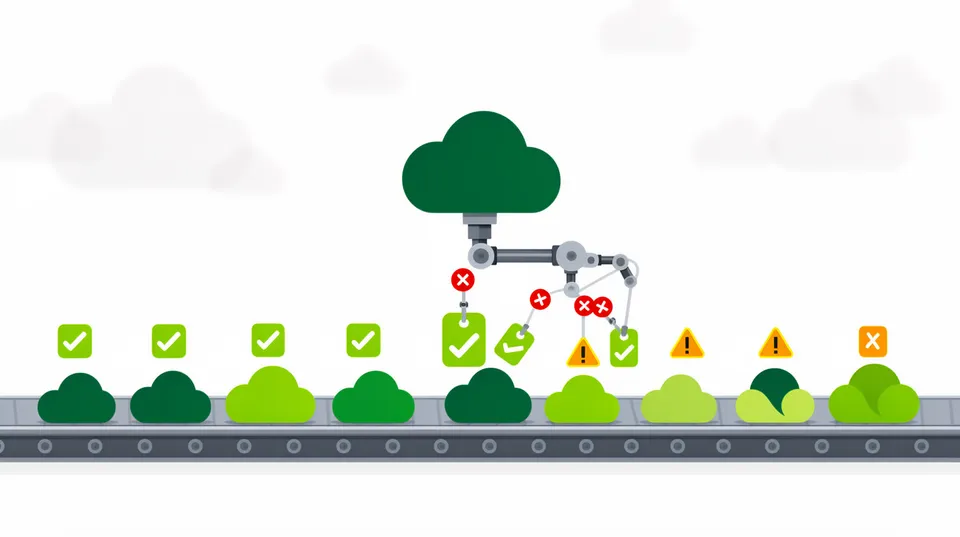
Consistent tagging transforms security operations from reactive to proactive. With reliable metadata on every asset, you can build automated workflows that drastically reduce the time it takes to fix identified issues. This is where the initial investment in a tagging strategy delivers its highest return.
From Alert Overload to Contextual Triage
Today's security teams are drowning in alerts. In 2025, each cloud asset had 115 vulnerabilities on average, creating an unsustainable volume of findings. A platform like Tamnoon can ingest these alerts from tools like CVE scanners, but their true power is unlocked when alerts are enriched with tag-based context. An alert about an open port on an EC2 instance is low-priority noise if it’s on a dev sandbox. The same alert on an instance tagged Environment: Prod and Compliance_Scope: PCI is a critical incident requiring immediate attention.
Tags allow for automated triage. Instead of analysts manually investigating every alert to determine its business impact, orchestration platforms can use tag data to prioritize findings automatically. This process helps teams focus their limited resources on the threats that pose a genuine risk to the business, a crucial step to fix CNAPP alert fatigue.
Driving Tag-Based Automated Remediation
With ownership and context established, remediation can be automated safely. When Tamnoon receives a high-severity alert from a CSPM about a misconfigured IAM role, its AI-driven engine uses the asset's tags to execute a precise, context-aware workflow:
- Identify the Owner: The platform reads the
Owner_EmailorTeamtag from the affected resource's metadata. - Select the Right Playbook: Based on the
Environmenttag, Tamnoon chooses a production-safe remediation blueprint. For an asset taggedEnvironment: Dev, it might automatically apply a fix. For aProdasset, it might instead initiate a human-in-the-loop workflow. - Route the Task Intelligently: It creates a ticket in Jira or sends a message in a specific Slack channel, assigning the task directly to the owner identified by the tag. The notification includes all context: the resource, the issue, and a recommended fix.
- Validate the Fix: After the remediation is applied, Tamnoon communicates back to the originating CSPM to trigger a re-scan, validating that the vulnerability is gone and closing the feedback loop.
This automated, tag-driven process moves organizations beyond just finding problems. It operationalizes remediation, turning detection into a concrete fix without the manual handoffs that cause delays. This is how leading organizations are measurably shrinking their cloud MTTR for misconfigurations.
Maintain Tagging Hygiene and Governance
Implementing a tagging strategy isn't a one-time project; it's a continuous process that requires ongoing governance to prevent drift and decay. Without maintenance, even the best tagging policy will fail over time as teams change, projects evolve, and new services are adopted.
Audit Continuously for Tag Drift
Tag hygiene requires constant vigilance. Use cloud-native tools like AWS Config, Azure Policy, and GCP's Policy Intelligence to run continuous audits against your tagging policy. These services can automatically detect resources that are missing mandatory tags or have non-compliant values. Configure automated alerts to notify the security team or the resource owner directly when non-compliance is detected. This creates a tight feedback loop that encourages immediate correction. Reporting on tag compliance metrics helps demonstrate the program's value and hold teams accountable.
Secure Developer Buy-in and Provide Training
Ultimately, developers and DevOps engineers are the ones provisioning resources, and their buy-in is essential. A top-down mandate without explanation will be met with resistance. It's critical to treat tagging as a shared responsibility and communicate its benefits clearly. Conduct training sessions that explain how consistent tagging helps them by enabling faster cost allocation, simplifying resource discovery, and, most importantly, reducing disruptive escalations from the security team. When developers understand that good tagging helps them resolve their own security issues faster, they become willing partners rather than obstacles. The fact that approximately 45% of all data breaches occur in cloud environments underscores the need for this shared responsibility.
Integrate Tagging into the Full Lifecycle
A mature organization integrates tagging into every part of the cloud resource lifecycle, from creation to decommissioning. It’s part of employee onboarding, a required step in CI/CD pipelines, a key metric in operational reviews, and the primary driver for automated remediation. With 86% of organizations making SaaS security a high priority, extending these ownership principles to all cloud services is more critical than ever.
By treating asset tagging as a foundational security control, organizations can close the dangerous ownership gaps that undermine cloud security. It allows platforms like Tamnoon to bridge the gap between detection and remediation, transforming security alerts from a list of problems into a queue of automated solutions. Stop chasing down owners in chat,start building the metadata-driven workflows that allow you to fix vulnerabilities at scale.

Tamnoon helps security teams remediate cloud risks faster with AI-augmented managed services — combining human expertise with automation so nothing falls through the cracks.
Learn more at tamnoon.ioFAQs
What is the best way to handle resistance from developers who see tagging as extra work?
The key is to frame tagging not as a bureaucratic burden, but as a direct benefit to them. Show developers how accurate `Owner` and `Project` tags lead to faster, more targeted notifications when something breaks, bypassing generic helpdesk tickets. Demonstrate how IaC modules with pre-filled tags reduce their manual effort. Finally, provide dashboards that show which teams have good tag hygiene, creating a sense of ownership and friendly competition. It shifts the conversation from compliance to operational efficiency.
How do I deal with cloud resources that don't support tagging?
While most modern cloud services support tagging, some older or specific services may not. For these cases, the principle of ownership must be applied differently. You can maintain a separate inventory in a CMDB or even a simple spreadsheet that maps these untaggable resources to their owners and applications. The goal is to ensure no asset is truly anonymous. Use naming conventions as a fallback, for example, prefixing a resource name with the project code (e.g., `phoenix-prod-user-db`) to provide some context, even if it's not as flexible as a tag.
What is a realistic timeline to implement a tagging strategy in a large enterprise?
For a large enterprise with a significant brownfield environment, a full implementation is a multi-quarter effort. Phase 1 (1-2 months) involves defining the policy, getting stakeholder buy-in, and implementing enforcement for all *new* resources via IaC and cloud policies. Phase 2 (3-6 months) is the cleanup of existing 'brownfield' assets, which can be automated with scripts and gamified with team-based dashboards. A realistic goal is to achieve 95%+ compliance on production-critical assets within six to nine months, with continuous auditing thereafter.
Can AI platforms like Tamnoon help fix tagging issues, or do they only consume tag data?
Advanced remediation platforms can do both. While their primary function is to consume tag data to drive intelligent remediation for security issues, they can also be configured to address tagging gaps. For instance, a playbook could be designed to identify resources missing an `Owner` tag by inferring ownership from other data points like the IAM user who created it or repository commit history. It could then suggest the appropriate tag or, in low-risk environments, automatically apply it, helping to improve tag hygiene over time.
My CSPM shows 'owners' for some resources. Why do I still need a separate tagging policy?
CSPM tools often infer ownership based on heuristics, such as the user who created the resource or Git history. This is helpful but often unreliable, especially for older resources or those created by service accounts. A formal tagging policy provides an explicit, authoritative source of truth that you control. An `Owner_Email` tag is a deliberate declaration of responsibility, which is far more dependable for automated workflows than an inference made by a third-party tool. It's the difference between a guess and a guarantee.