

Your CSPM just found 5,000 "critical" vulnerabilities. A normal Monday. For security teams, this isn't intelligence; it's inventory. An ever-growing list of problems that rarely translates into a proportional reduction in risk. This is the core failure of the modern security stack. Detection tools like Wiz, Prisma Cloud, and Orca Security are exceptionally good at finding issues, but their job stops there, leaving you at the most dangerous part of the process: remediation.
This mountain of data creates a paradox. The more you see, the less you can act on. This isn't just a feeling; 47% of analysts point to alerting issues as the most common source of inefficiency in the SOC. The bottleneck isn't detection. It's the operational friction, the risk of breaking production, and the sheer manual effort required to translate a finding from a dashboard into a safe, deployed fix. Alerts themselves don't defend anything; they're just documentation of your exposure.
The real work begins after the alert fires. It involves decoding dependencies, understanding business context, and navigating the political landscape between security, DevOps, and engineering. Without a systematic approach to remediation that respects production stability, your expensive security stack is just a sophisticated alarm that nobody has time to answer. It's time to re-frame the problem from finding flaws to fixing them safely at scale.
Deconstruct the Alert Flood From Your CSPM
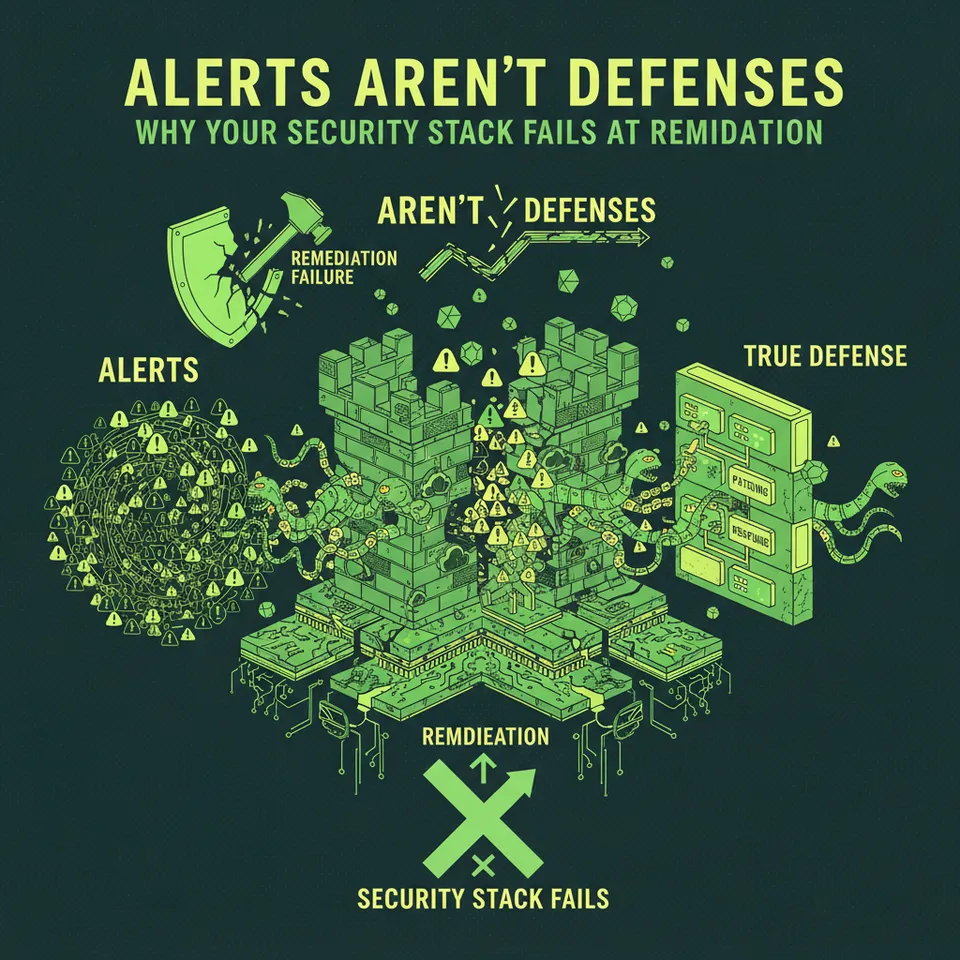
The constant stream of alerts isn't a bug in your CNAPP or CSPM; it's a fundamental design characteristic. These platforms are built for maximum coverage and detection, which inherently means they generate volume. They treat every instance of a problem as a unique alert, leading to an unmanageable queue. If a vulnerable Log4j library exists in a base image used by 200 microservices, you don't have one problem,you have 200 alerts clogging up your system.
This problem is compounded by a lack of context. A typical scanner sees a publicly accessible S3 bucket and immediately flags it as a critical finding. But is it? If that bucket hosts public website assets, the finding is a false positive. However, a private S3 bucket with a misconfigured policy that grants access to a long-forgotten developer role could be a genuine, high-risk exposure, even if the scanner rates it as "medium." The alert itself doesn't provide this crucial business context.
Security teams know this well. They're forced to spend a huge portion of their time investigating alerts that turn out to be noise, which is why over 50% of SIEM alerts are false positives. To move forward, you must have a way to enrich these raw findings with operational intelligence. This means correlating alerts, understanding the asset's business value, analyzing its reachability, and determining the true blast radius before a ticket is ever created.
Move From Triage to a Production-Safe Fix
Let's walk through a common, high-risk scenario: remediating an over-privileged IAM role used by a production Lambda function. Your CSPM flags the role because it has the AdministratorAccess managed policy attached. This is a five-alarm fire on paper, but acting rashly will cause an outage. Here’s a pragmatic approach to remediation that prioritizes safety.
Before: The Agony of Manual Context Gathering
Without a remediation-focused platform, an engineer receives this alert and begins a painful investigation. First, they need to identify which permissions the function actually uses. This involves digging through months of CloudTrail logs, filtering by the role's ARN, and manually compiling a list of API actions like s3:GetObject and dynamodb:PutItem. They might even have to read the function’s source code to understand its logic.
Next, they have to consult the application owners. "What does this function do? Can we afford for it to go down?" This process of chasing people and logs is exactly why security teams waste 43% of their time on manual context gathering. It's slow, error-prone, and kills productivity, leaving the vulnerability open for weeks or months.
After: Automated Least-Privilege Policy Generation
A modern remediation operations platform automates this entire discovery phase. It connects to AWS APIs to pull usage data directly from services like IAM Access Advisor. Instead of manual log parsing, it programmatically determines which of the 700+ permissions in AdministratorAccess have been used in the last 90 or 180 days. The answer is usually fewer than ten.
Based on this data, the platform generates a perfectly scoped, least-privilege IAM policy. The process moves from manual guesswork to data-driven code generation. Here's a simplified look at the before and after:
Before: The Over-Privileged Policy
{ "Version": "2012-10-17", "Statement": [ { "Effect": "Allow", "Action": "*", "Resource": "*" } ]
}
After: The Remediated, Least-Privilege Policy
{ "Version": "2012-10-17", "Statement": [ { "Sid": "S3Access", "Effect": "Allow", "Action": [ "s3:GetObject", "s3:PutObject" ], "Resource": "arn:aws:s3:::prod-data-bucket/*" }, { "Sid": "DynamoDBAccess", "Effect": "Allow", "Action": "dynamodb:UpdateItem", "Resource": "arn:aws:dynamodb:us-east-1:123456789012:table/prod-metadata-table" } ]
}
This new policy is not a guess. It's a surgical change based on verified usage data, drastically reducing the attack surface without impacting the function's operation.
Implement the Fix Without Breaking Production
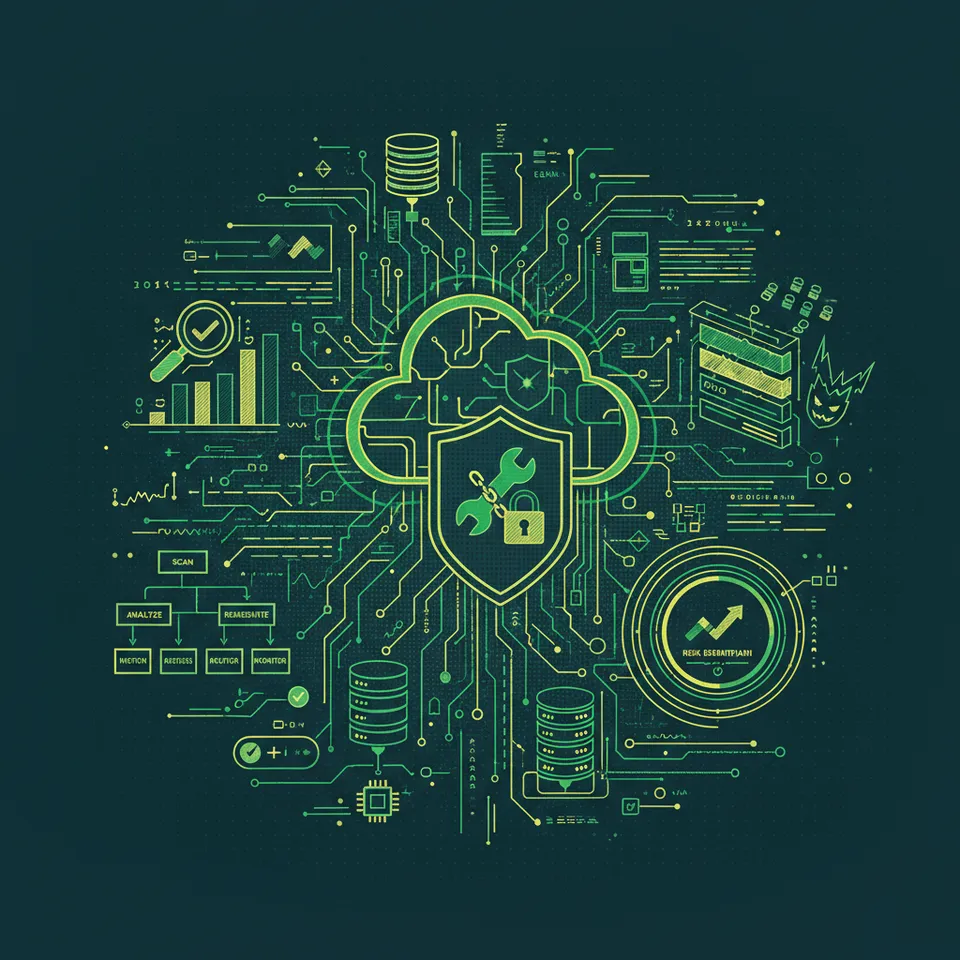
Generating the correct policy is only half the battle. Deploying it without causing an outage requires a workflow that respects how modern cloud infrastructure is managed. Clicking "Apply" in the AWS console is not an acceptable option for any team using Infrastructure as Code (IaC).
Prioritize IaC-Native Remediation
A production-safe remediation must be an IaC-native one. Any manual change made directly in the cloud provider's console creates configuration drift, where the live environment no longer matches the source code in Git. This drift invalidates your IaC templates and creates a nightmare for the next deployment.
A remediation platform like Tamnoon understands this. Instead of just applying the new IAM policy, it identifies the source Terraform or CloudFormation file and generates a pull request with the necessary code changes. The DevOps engineer receives a notification in Slack with a link to a PR in GitHub. The PR clearly shows the old AdministratorAccess policy being replaced by the new, tightly scoped policy. All they have to do is review, approve, and merge. This approach reduces the chance of things going wrong, as discussed in our guide on managing playbook risk.
Have a Verifiable Rollback Strategy
Even with the best preparation, things can go wrong. What if the usage analysis missed a once-a-quarter cleanup job run by the Lambda function? The new policy would break it. A robust remediation process must include a pre-defined and tested rollback plan. In an IaC world, this is straightforward: revert the pull request and re-apply the Terraform configuration. The key is that this procedure is documented and baked into the remediation playbook itself, so there's no panic during a failed deployment.
Build a Remediation Operations (RemOps) Workflow
Solving these problems one-by-one is not scalable. To truly get ahead of the alert flood, you need to industrialize your fix process. This is the goal of Remediation Operations (RemOps), a cultural and technical framework for treating remediation as a standard, measurable part of your engineering lifecycle, not a series of one-off fire drills.
A RemOps workflow connects your detection tools, contextual data sources, and deployment pipelines into a cohesive system. The goal is to shrink your Mean Time to Remediate (MTTR) by removing manual steps and communication bottlenecks. Too many organizations are struggling here; research shows 61% of security leaders agree their organization lacks the ability to identify and remediate exposures in their cloud environments. RemOps directly addresses this capability gap.
Key pillars of a successful RemOps program include:
- Unified Ownership and Context: Automatically enrich alerts with business context. Use a combination of CMDB data and cloud tags to identify the asset owner. This simple step can eliminate days of back-and-forth trying to find the right team to handle a ticket. You can learn more about this in our post on closing security ownership gaps.
- Risk-Based Prioritization: Don’t rely solely on CVSS scores. Prioritize vulnerabilities that are actively exploited in the wild. Integrating feeds like the CISA Known Exploited Vulnerabilities (KEV) catalog helps focus your team’s limited bandwidth on the threats that matter most right now.
- Lifecycle Automation: Automate every step of the remediation lifecycle that doesn't require human judgment. This includes alert ingestion, context gathering, fix generation, ticket creation in Jira, and IaC pull requests. The human expert should be a reviewer and approver, not a manual laborer.
- Continuous Validation and Measurement: After a fix is deployed, the system should automatically re-scan the asset to validate that the vulnerability is gone. Track metrics like MTTR by team, vulnerability type, and business unit to demonstrate real risk reduction to leadership, guided by frameworks like NIST Special Publication 800-53.
Your security stack will keep finding problems. A RemOps culture gives you the factory to fix them. It transforms security from a source of friction into a streamlined operational capability. The goal isn't just to close tickets; it's to build a more resilient and secure cloud environment by default.
Check out how Tamnoon helps operationalize these workflows to clear your backlog for good.

Tamnoon helps security teams remediate cloud risks faster with AI-augmented managed services — combining human expertise with automation so nothing falls through the cracks.
Learn more at tamnoon.ioFAQs
What's the main difference between a CSPM and a remediation platform?
A CSPM's primary job is detection. Its output is a list of findings, such as misconfigurations or vulnerabilities. A remediation platform focuses on resolution. Its output is a concrete, actionable fix, like a generated IaC pull request, a verified CLI command, or a step-by-step playbook. While a CSPM tells you *what* is broken, a remediation platform provides the context and tooling to tell you *how* to fix it safely without disrupting your production environment.
How can I be sure an automated fix won't break my production application?
Production safety is achieved through multiple layers of validation. A strong remediation platform doesn't just run a script. It first performs impact analysis by checking cloud logs for actual usage and analyzing network reachability. It then generates the fix as code, preferably for your IaC tool like Terraform or CloudFormation. Finally, it uses a 'human-in-the-loop' model, where the automated fix is presented as a pull request for expert review by a DevOps or SRE team member before it's ever deployed.
I already have a scanner like Wiz or Prisma Cloud. Can I still use Tamnoon?
Yes, absolutely. Tamnoon is designed to be the action layer for your existing detection tools. It integrates with scanners like Wiz, Orca, and Prisma Cloud to ingest their alerts. It then enriches these findings with operational context, deduplicates them, and orchestrates the entire remediation lifecycle. Instead of replacing your scanner, Tamnoon makes it more valuable by turning its raw data into resolved issues, effectively solving the 'last mile' problem of security.
What is RemOps and why is it important for cloud security?
RemOps, or Remediation Operations, is a framework that treats fixing security flaws as a standard, measurable operational process, much like CI/CD. It's important because manual, ad-hoc remediation can't keep pace with the speed of cloud development or modern attacks. RemOps formalizes the process by defining ownership, automating context gathering, prioritizing fixes based on real risk, and integrating remediation into existing developer workflows (like Git), fundamentally reducing Mean Time to Remediate (MTTR).
How should a remediation platform handle Infrastructure as Code (IaC) drift?
An effective remediation platform must prioritize fixing issues at the source to prevent IaC drift. When a vulnerability is found in a running resource that was deployed via Terraform, for example, the wrong approach is to change the setting in the live environment. The correct approach is for the platform to identify the source code repository, generate the corrected HCL code, and submit a pull request against the `main` branch. This ensures the fix is permanent, version-controlled, and consistent with GitOps best practices.