

Flipping the switch on automated secret rotation for a production database is a high-stakes bet.
While every security framework from NIST to OWASP champions the practice, the operational risk is what keeps engineers up at night. A botched rotation doesn't just create a security ticket; it triggers a P0 incident, breaks application connectivity, and halts business operations. The fear of a self-inflicted outage often leads to indefinite deferral, leaving long-lived credentials exposed and defeating the entire purpose of a robust DevSecOps culture.
The challenge isn't convincing people that stale secrets are bad. The real work is building a rotation mechanism that's resilient, testable, and, most importantly, doesn't break production. This requires moving beyond theoretical best practices and into the weeds of operational implementation, rollback strategies, and production-safe remediation workflows.
Deconstruct the Production Impact of a Botched Rotation
Before implementing any automation, you first have to understand what breaks when a secret rotation fails. The blast radius isn't theoretical. It’s a cascade of failures that can be difficult to trace under pressure.
A primary failure point is application-to-database connectivity. When a database credential rotates but the application fails to fetch the new one, every transaction fails. This can manifest as login errors for users, failed API calls for microservices, and a flood of application-level exceptions. In a distributed system, this can be especially damaging, as one service's inability to reach the database can cause a chain reaction of failures in upstream services.
Another common point of failure is within the CI/CD pipeline itself. If deployment scripts or integration tests rely on a static credential that suddenly changes, pipelines will fail. This blocks new code from reaching production, halting development velocity and preventing engineers from deploying a potential fix for the original outage, compounding the problem.
Build Your Rotation Framework for Zero-Downtime
A resilient rotation system isn't a single tool but an architecture. It starts with a centralized manager and extends through your Infrastructure as Code (IaC) and serverless functions, with resilience built-in at each layer. This approach is fundamental to managing risk in complex environments, a concern that too often leads to automated remediation breaking production.
Choose a Secret Manager with Native Rollback
Your choice of secret manager directly impacts your ability to recover from a failed rotation. The major cloud providers' offerings are the logical starting point for most teams.
- AWS Secrets Manager: Offers native rotation capabilities for services like RDS, Redshift, and DocumentDB using AWS Lambda. Its key feature for resilience is the use of staging labels (e.g.,
AWSCURRENT,AWSPENDING,AWSPREVIOUS). If a rotation fails after the test phase, theAWSCURRENTlabel remains on the old, working secret, providing a built-in rollback path. - Azure Key Vault: While it doesn't have the same built-in rotation templates as AWS, it integrates with Azure Event Grid and Azure Functions. You can build a robust system by emitting an event near a secret's expiry, triggering a function to perform the rotation. Your custom logic must include version management to handle rollbacks.
- GCP Secret Manager: Uses a similar model to Azure, relying on Pub/Sub topics and Cloud Functions to orchestrate rotation. You define a rotation schedule on a secret, which publishes a message to a topic, triggering your function.
For any of these, the rotation logic itself must be idempotent, meaning it can be run multiple times without causing a different outcome. This is crucial if the function is retried after a transient failure.
Implement the Four-Step Rotation Pattern
The rotation function, whether it's an AWS Lambda or an Azure Function, should follow a standardized, four-step process to ensure safety. This pattern is enforced by the native AWS Secrets Manager Lambda templates but should be replicated in any custom solution.
Here's a Python-based example of the logic for a custom Lambda function:
# Simplified pseudo-code for a rotation Lambda def lambda_handler(event, context): secret_id = event['SecretId'] client_token = event['ClientRequestToken'] step = event['Step'] if step == "createSecret": # 1. Create a new version of the secret # Call the target service (e.g., external API) to generate a new key new_password = generate_new_api_key() secretsmanager.put_secret_value( SecretId=secret_id, ClientRequestToken=client_token, SecretString=new_password, VersionStages=['AWSPENDING'] ) elif step == "setSecret": # 2. Update the service with the new secret # This step is where you would update the database user or API configuration update_service_with_new_password(new_password) elif step == "testSecret": # 3. Test that the new secret works # Attempt to connect to the service using the new secret from AWSPENDING is_valid = test_connection_with_new_password(new_password) if not is_valid: raise ValueError("Test of the new secret failed.") elif step == "finishSecret": # 4. Finalize rotation by moving the AWSCURRENT label # The old secret automatically becomes AWSPREVIOUS secretsmanager.update_secret_version_stage( SecretId=secret_id, VersionStage='AWSCURRENT', MoveToVersionId=client_token ) else: raise ValueError("Invalid step parameter")
The testSecret step is the most critical guardrail. If this test fails, the process aborts, and the AWSCURRENT secret remains untouched, preventing an outage. Your application code should be written to fetch the secret with the AWSCURRENT label, ensuring it always gets the active, validated credential.
Operationalize Rotation with Production-Safe Guardrails
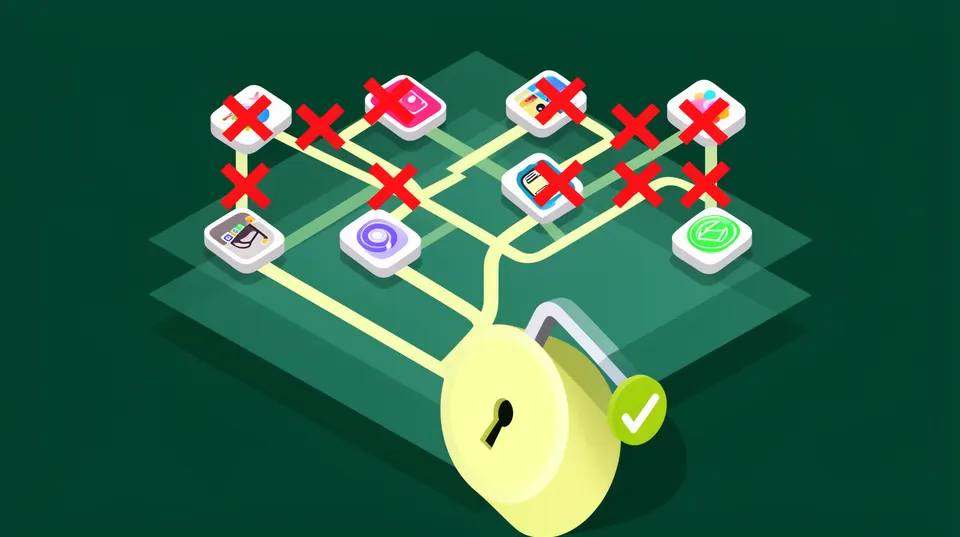
With a resilient technical framework in place, the focus shifts to operational discipline. This involves defining your process in code, implementing gradual rollouts, and having a well-rehearsed plan for when things go wrong. After all, a tool is only as good as the process wrapped around it.
Define Rotation as Code
Managing rotation schedules and function configurations manually via a console is brittle and unscalable. Use an IaC tool like Terraform or CloudFormation to define the entire secret lifecycle. This provides auditability, version control, and consistency across environments.
This Terraform snippet defines an AWS secret and its rotation configuration, ensuring rotation is enabled by default for any new secret of this type.
resource "aws_secretsmanager_secret" "prod_db_creds" { name = "production/database/credentials"
} resource "aws_secretsmanager_secret_version" "initial_creds" { secret_id = aws_secretsmanager_secret.prod_db_creds.id secret_string = "initial-placeholder-password"
} resource "aws_secretsmanager_secret_rotation" "db_rotation_config" { secret_id = aws_secretsmanager_secret.prod_db_creds.id rotation_lambda_arn = aws_lambda_function.secret_rotation_lambda.arn rotation_rules { automatically_after_days = 30 } depends_on = [aws_secretsmanager_secret_version.initial_creds]
} # IAM roles and Lambda function for rotation logic would be defined here...
By managing this in code, you can use static analysis tools in your CI pipeline to enforce policies, such as flagging any new secret definition that's missing a rotation_rules block. This shifts security left, preventing the creation of unmanaged, static secrets. This kind of automation is a key driver in the DevSecOps market, where secure CI/CD pipelines account for a significant portion of adoption.
Plan for Failure with Rollbacks and Canary Releases
Even with testing, production is different. A dependency you missed or a subtle environmental difference can cause a failure. You need a clear rollback plan. For secret managers that use versioning, the simplest rollback is to re-promote the AWSPREVIOUS version back to AWSCURRENT. This must be a documented, semi-automated process your on-call engineers can execute quickly.
For highly critical services, avoid a big-bang rotation. Use a canary release pattern. If your application runs on a fleet of 20 servers, configure your rotation process to update the application configuration on just one or two servers first. Monitor them for errors for a set period (e.g., 15 minutes). If they remain healthy, proceed with rolling out the secret to the rest of the fleet. This limits the blast radius of a failure to a small subset of your users.
Bridge the Gap Between Detection and Safe Remediation
Your CNAPP or CSPM tool, whether it's Prisma Cloud, Wiz, or Orca, is great at finding problems. It will inevitably generate a list of alerts: “Secret not rotated in 90 days,” “IAM policy allows overly permissive access to Key Vault,” “Hardcoded key found in Lambda environment variable.” But an alert is not a fix. The gap between detection and remediation is where risk accumulates.
Nearly 1,000 cloud environments were found vulnerable to exploitation due to simple misconfigurations, a problem detection tools are designed to find. Yet the alerts persist because fixing them in a complex environment is risky. An engineer who receives a ticket to enable rotation on a legacy RDS instance has to ask: What services use this? Will they pick up the new secret? What's the rollback plan if they don't?
This is the exact problem Tamnoon is built to solve. Instead of just flagging a non-compliant secret, Tamnoon’s platform analyzes the alert's full context, including dependencies and potential production impact. It then generates a production-safe remediation playbook. This isn't just a recommendation; it's an actionable plan, often in the form of IaC, that can be reviewed and deployed through your existing CI/CD workflow.
For a high-risk change, like enabling rotation for a shared production database, Tamnoon injects a human-in-the-loop validation step. A cloud security expert reviews the AI-generated plan, validates its safety, and provides the green light, giving your team the confidence to execute the fix. This transforms a scary alert into a resolved issue, drastically shrinking your MTTR for critical misconfigurations without introducing operational risk.
By connecting the dots from detection to a safe, validated fix, you can finally clear your backlog of secret-related alerts and build a truly fortified, cloud environment. Explore how Tamnoon can help close your remediation gaps and make automated secret rotation an operational reality, not just a security goal.

Tamnoon helps security teams remediate cloud risks faster with AI-augmented managed services — combining human expertise with automation so nothing falls through the cracks.
Learn more at tamnoon.ioFAQs
What's the biggest operational risk in automated secret rotation and how do you mitigate it?
The single biggest risk is causing a production outage. This happens when a secret is rotated, but a consuming application fails to retrieve the new credential, breaking its connection to a database or API. Mitigation involves a multi-layered strategy: rigorous testing in a pre-production environment, implementing idempotent rotation logic that includes a 'test' step before finalizing, using a canary release pattern to roll out the new secret to a small subset of services first, and having a well-documented, rapid rollback procedure to revert to the previous known-good secret version.
How do I choose between AWS Secrets Manager, Azure Key Vault, and HashiCorp Vault?
The choice depends on your cloud strategy. If you're heavily invested in a single cloud (e.g., AWS), the native service like AWS Secrets Manager is often best. It offers tight integration with other cloud services (like RDS) and simplified IAM controls. For multi-cloud or hybrid environments where credentials span across AWS, Azure, GCP, and on-prem, a cloud-agnostic solution like HashiCorp Vault provides a unified control plane. Azure Key Vault and GCP Secret Manager are strong choices within their ecosystems, but often require more custom development for rotation logic compared to AWS's pre-built templates.
My legacy application doesn't support dynamic secret retrieval. Can I still automate rotation?
Yes, but it requires a different approach. If the application only reads its configuration on startup, your automation process must include a step to trigger a rolling restart of the application instances after the secret has been rotated. You can use container orchestration platforms like Kubernetes or service managers like systemd to manage this gracefully. Another pattern is using an init container that fetches the secret from the vault and writes it to a file or environment variable that the main application container can then consume upon startup.
How can I enforce automated secret rotation policies within my CI/CD pipeline?
Enforcement should happen through Infrastructure as Code (IaC) validation. In your CI pipeline, use tools like Checkov or tfsec to scan your Terraform or CloudFormation code. You can write custom policies that cause the build to fail if a new `aws_secretsmanager_secret` resource is defined without an associated `aws_secretsmanager_secret_rotation` block or if the `rotation_rules` are missing. This acts as a guardrail, preventing developers from provisioning secrets that don't adhere to your rotation standards from the outset, embedding security directly into the development workflow.
How does Tamnoon improve upon the findings from my CSPM for secret-related issues?
A CSPM like Wiz, Orca, or Prisma Cloud excels at detection; it tells you *what's* broken. Tamnoon focuses on the next crucial step: *how to fix it safely*. When a CSPM flags a non-rotating secret, Tamnoon's platform analyzes the asset's context and dependencies to generate a production-safe remediation playbook, often as IaC. For high-risk changes, it integrates human-in-the-loop expert validation to prevent outages. It transforms a raw alert into a vetted, actionable, and often automated fix, bridging the dangerous gap between detection and resolution.