

Unassigned cloud resources create blind spots that attackers exploit. Without clear ownership and consistent tagging, security teams struggle to pinpoint accountability, prioritize risks, and remediate vulnerabilities efficiently, increasing operational overhead and breach potential.
Cloud environments grow complex, making asset visibility and control difficult. Unmanaged or improperly tagged assets become compliance liabilities and security gaps, directly impacting an organization's ability to maintain a strong security posture. This problem compounds alert fatigue, where security findings lack the context for quick resolution.
Effective cloud asset ownership and tagging practices are foundational to a strong governance framework, enabling faster remediation and reduced operational friction. Establishing these practices isn't just about compliance. It's about making security operations viable in a large-scale cloud environment.
Why Clear Ownership and Tagging are Critical for Cloud Security Remediation
Clear ownership and consistent tagging directly impact security remediation by providing essential context, allowing security and operations teams to identify responsible parties and asset criticality quickly. When an alert fires, knowing who owns the resource and what purpose it serves is the difference between a stalled investigation and rapid resolution. Without this information, alerts become noise, contributing to alert fatigue and increasing the mean time to remediation (MTTR).
Consider a scenario where a high-severity alert from a CNAPP like Wiz, Orca Security, or Palo Alto Cortex Cloud flags an exposed S3 bucket. If that bucket lacks owner tags, the security team can't immediately notify the responsible development team or product owner. This leads to time wasted sifting through internal wikis or directory services, escalating the issue, and potentially impacting production. Clear ownership allows for direct communication, while comprehensive tagging helps prioritize. For example, a tag indicating a 'production' environment or 'PCI-DSS scope' immediately flags the asset as high-priority, driving swifter action. This operational efficiency is key for reducing MTTR, especially when dealing with the sheer volume of alerts generated by modern cloud security tools.
The operational cost of unmanaged cloud assets is substantial. Organizations can find themselves paying for sprawl in more ways than one, beyond just security issues. Cloud cost pressure pushes organizations to scrutinize workload placement, instance selection, and region usage, which all benefit from clear ownership and tagging. Each unmanaged change expands exposure, and it's often difficult to trace who's accountable, as noted by Wiz's insights on attack surface monitoring. The global data governance market is valued at $5.38 billion in 2025 and is projected to reach $18.07 billion by 2032, underscoring the growing recognition of this problem's financial and security implications. These figures highlight the increasing investment in solutions that bring order to cloud chaos, demonstrating that the industry recognizes the direct correlation between good governance and reduced risk.
Defining Cloud Asset Ownership
Defining ownership isn't just about assigning a name to a resource. It's about clearly demarcating responsibility for its security, compliance, and lifecycle. An owner is the individual or team accountable for the asset's configuration, its data, and its adherence to organizational policies. This includes responsibilities like ensuring proper access controls, maintaining up-to-date software, and responding to security alerts related to that asset. Without this clear line of accountability, security issues often fall into a remediation gap, where everyone assumes someone else is handling it, or worse, no one is aware a problem even exists. For critical assets, establishing primary and secondary owners, along with emergency contacts, is a good practice. This structure ensures that even when a primary owner is unavailable, the remediation process doesn't stall, which directly contributes to lowering MTTR.
Understanding Cloud Tagging Strategies
Tagging is the technical mechanism that codifies ownership and other critical metadata directly onto cloud resources. Effective tagging strategies involve establishing a standardized set of tags, their permissible values, and a policy for their mandatory application. Common tags include Owner, Environment (e.g., prod, dev, staging), CostCenter, Project, Application, and DataClassification (e.g., public, confidential, restricted). These tags serve multiple purposes beyond just security. They assist with cost allocation, automation, and compliance reporting. For example, a DataClassification:restricted tag on a database instance would trigger more stringent security policies and monitoring, signaling to remediation platforms like Tamnoon that any identified vulnerabilities on this asset require immediate, prioritized attention. The value of such granular context is that it allows security teams to focus efforts where they matter most, avoiding the noise of less critical alerts. This is how organizations move beyond simply detecting issues to actually fixing them with business context.
Implementing Ownership and Tagging in Major Cloud Providers
Standardizing ownership and tagging across cloud providers requires utilizing native services for policy enforcement and Infrastructure as Code (IaC) for consistent deployment. Each major cloud provider offers mechanisms to implement these controls, but the key is to integrate them into a unified governance strategy. This integration ensures that regardless of where an asset resides, its ownership and metadata are discoverable and actionable.
For example, AWS provides AWS Organizations with Service Control Policies (SCPs) to enforce tagging policies across accounts. Azure uses Azure Policy to audit and enforce tag compliance, while Google Cloud has Resource Manager Tags and Policy Organization. Centralizing these policies helps prevent shadow IT and untagged resources from proliferating.
AWS Ownership and Tagging
In AWS, implementing ownership and tagging involves a combination of IAM policies, AWS Config rules, and service-specific automation. You'll want to mandate specific tags during resource creation. AWS Control Tower excels at managing cloud asset tagging for governance and automatically detects assets, providing a centralized control plane for multi-account environments. This tool helps enforce mandatory tags through policy-driven guardrails.
Here's a basic CloudFormation snippet that mandates an 'Owner' tag for an S3 bucket:
Resources: MySecureBucket: Type: AWS::S3::Bucket Properties: BucketName: my-critical-app-data-bucket Tags: - Key: Owner Value: team-security-apps - Key: Environment Value: production - Key: CostCenter Value: 12345
For existing resources, AWS Config can detect non-compliant resources, triggering remediation actions. An AWS Config rule could check if all S3 buckets have an Owner tag. If not, an SNS notification could alert the security team or trigger a Lambda function to add a default tag, or even quarantine the resource. Tamnoon integrates with these alerts, providing automated remediation playbooks. For instance, if an S3 bucket is found without a required ownership tag or with incorrect public access settings, Tamnoon can initiate a playbook to either add the correct tag or restrict public access, ensuring the fix is production-safe and doesn't break dependent applications.
Azure Ownership and Tagging
Azure leverages Azure Policy for comprehensive governance, including tagging enforcement. You can create policies to require specific tags on resources within a subscription or management group. These policies can audit for missing tags, deny resource creation if tags are absent, or even append default tags.
A simple Azure Policy definition in JSON to require an 'Owner' tag:
{ "if": { "allOf": [ { "field": "type", "equals": "Microsoft.Storage/storageAccounts" }, { "field": "tags['Owner']", "exists": "false" } ] }, "then": { "effect": "audit" }
}
This policy audits storage accounts without an 'Owner' tag. For enforcement, you'd change "effect": "audit" to "effect": "deny". These policy violations feed into Azure Security Center (now Defender for Cloud), which Tamnoon monitors. When a resource is identified as non-compliant due to missing or incorrect tags, Tamnoon's AI-powered remediation engine can suggest and execute the necessary tagging operations, often with agentic prioritization to ensure the most critical issues are addressed first. Microsoft Learn mentions that the indirectly connected mode for Azure Arc-enabled data services retired as of September 2025, which reinforces the need for robust, directly managed governance solutions.
Google Cloud Ownership and Tagging
[object Object]Applying a tag via gcloud:
gcloud compute instances add-labels instance-1 \ --zone=us-central1-a \ --labels=owner=security-team,environment=production
Google Cloud Asset Inventory also excels at managing cloud asset tagging for governance and automatically detects assets. This service provides a comprehensive view of all resources, their metadata, and policies, making it easier to identify untagged or mis-tagged assets. When Google Cloud Security Command Center detects a misconfiguration or security issue on an asset lacking proper ownership tags, Tamnoon can ingest this alert. It then uses AI-powered remediation to identify the probable owner based on other contextual data and then either suggest or apply the appropriate tags, ensuring the asset is correctly classified and can be prioritized for further security actions. The OWASP Top 10 for LLM Application Security Project expanded its focus in early 2024 to include developers, data scientists, and security professionals, indicating a broader need for integrated governance as new technologies emerge.
Automating Tag Enforcement and Remediation Workflows
Automating tag enforcement and remediation workflows is essential to maintain consistent governance at cloud scale, using policy-as-code and integrated security platforms to close the loop between detection and fix. Manual tagging is error-prone and unsustainable in cloud environments. Automated solutions ensure that new resources are born compliant and that existing ones are corrected without human intervention slowing down security operations.
Infrastructure as Code (IaC)
IaC tools like Terraform, CloudFormation, and Azure Resource Manager (ARM) templates are the first line of defense for tag enforcement. By defining resource tags directly within IaC templates, you ensure that every provisioned resource starts with the correct metadata. This shifts tag enforcement left, catching issues before deployment. Teams can use pre-commit hooks and CI/CD pipeline checks to validate IaC templates against tagging policies, failing builds that don't adhere to standards.
Here's a Terraform example demonstrating mandatory tags for an EC2 instance:
resource "aws_instance" "web_server" { ami = "ami-0abcdef1234567890" instance_type = "t2.micro" tags = { Name = "web-server-prod" Owner = "app-dev-team" Environment = "production" Project = "frontend" }
}
This approach makes tagging a fundamental part of resource creation, reducing the likelihood of untagged assets. Integrating this into CI/CD pipelines ensures that any resource deployed via automation is consistently tagged.
Integrating with Cloud Security Platforms
Cloud Security Posture Management (CSPM) and Cloud-Native Application Protection Platforms (CNAPP) like Wiz, Orca Security, and Prisma Cloud are critical for detecting untagged or mis-tagged resources post-deployment. These tools continuously scan cloud environments against defined policies, identifying deviations. However, detection is only half the battle. This is where remediation orchestration comes in.
Tamnoon integrates with these platforms, ingesting alerts for tagging non-compliance. When a CNAPP flags an untagged resource or one with an incorrect ownership tag, Tamnoon's AI-powered remediation engine analyzes the alert, determines the most appropriate fix, and generates a production-safe playbook to apply the correct tags. This could involve updating resource tags via cloud APIs or even triggering a pull request to update the originating IaC template. The human-in-the-loop validation ensures that complex remediations don't disrupt operations, providing a safety net for automated fixes.
"Cloud security requires more than just detection. It demands rapid, production-safe remediation. Without clear asset ownership and consistent tagging, the best detection tools only generate more alerts, not fewer risks."
CISA
Establishing Remediation Playbooks for Tagging Issues
Remediation playbooks are pre-defined, automated sequences of actions to fix common security issues. For tagging, playbooks can include steps like:
- Identify the untagged resource reported by a CNAPP (e.g., a new EC2 instance without an
Ownertag). - Query a CMDB or internal asset registry to determine the probable owner based on IP range, associated subnet, or creation time/user.
- Apply the missing tags via the cloud provider's API or CLI.
- Verify the tags are applied correctly using the CNAPP or cloud native tools.
- Notify the owner and security team of the successful remediation.
Tamnoon provides automated remediation playbooks that can be customized for specific tagging policies. For critical assets, the playbook might require human approval before applying tags, especially if inferring ownership. For less critical assets or environments, full automation can be deployed. This approach allows security teams to manage thousands of alerts without being overwhelmed, bridging the gap between alert detection and actual resolution. For instance, in 2024, threat actors chained vulnerabilities, CVE-2024-8963 in conjunction with CVE-2024-8190, in Ivanti Cloud. While not directly related to tagging, incidents like this highlight the critical need for an organized, well-governed cloud environment where every asset's purpose and ownership are clearly understood, enabling rapid response to such complex threats.
Operationalizing Governance Through Continuous Monitoring and Auditing
Operationalizing governance requires continuous monitoring and auditing to ensure tagging policies remain effective and catch drift, thereby preventing the resurgence of untagged or mis-tagged resources over time. A one-time tagging effort isn't sufficient. Cloud environments are, with resources constantly being created, modified, and deleted. An ongoing process is necessary to maintain the integrity of ownership and tagging information.
Establishing Continuous Monitoring
[object Object]The monitoring process shouldn't only detect non-compliance but also track trends. Are certain teams consistently failing to tag resources? Are there specific resource types that are frequently untagged? This data helps refine policies, improve developer education, and focus automation efforts where they'll have the biggest impact. By understanding these patterns, security teams can proactively address root causes rather than just reacting to individual incidents. This continuous feedback loop is crucial for building a mature cloud governance program.
Auditing and Reporting on Tagging Compliance
Regular auditing and reporting are for demonstrating compliance to internal stakeholders and external auditors. Reporting should cover:
- The percentage of resources compliant with tagging policies.
- Top offenders (teams, projects, or resource types with the most non-compliant resources).
- Trends in tagging compliance over time.
- The effectiveness of automated remediation efforts.
Many CSPMs offer built-in reporting capabilities. Additionally, Tamnoon's reporting and compliance features provide granular insights into remediation actions taken for tagging issues, including success rates and the MTTR for these specific types of findings. This data helps measure the ROI of governance initiatives and identifies areas for further improvement. For example, if reports show a persistent backlog of untagged resources from a specific department, it signals a need for targeted training or more aggressive automated enforcement for that group. This proactive adjustment keeps the governance framework adaptable and relevant to the organization's evolving cloud footprint. This ongoing process helps maintain an impervious cloud security configuration baseline.
Integrating with Security Orchestration, Automation, and Response (SOAR)
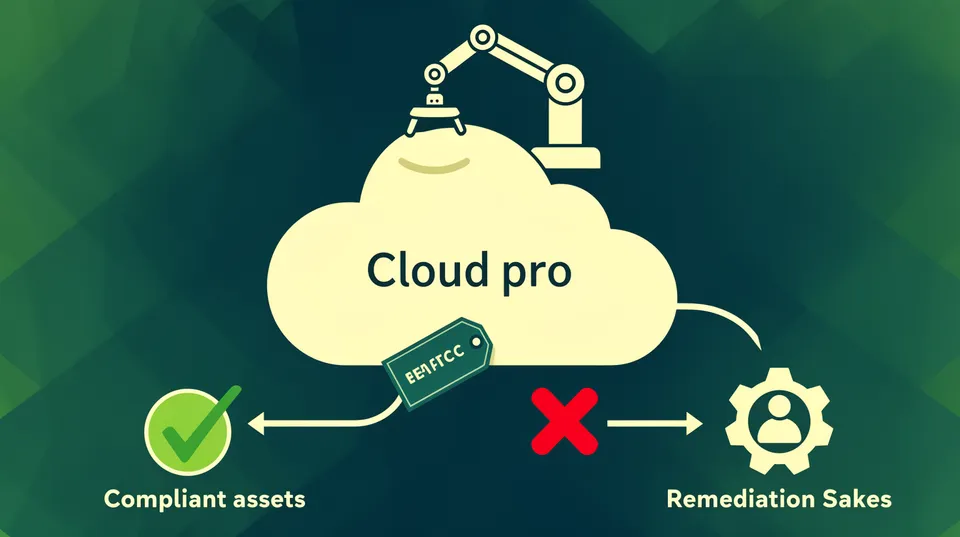
For large enterprises, integrating tagging governance with SOAR platforms streamlines the response to non-compliant assets. When a monitoring tool flags a tagging issue, the SOAR platform can ingest the alert, enrich it with contextual data (e.g., owner information from an identity management system), and trigger a Tamnoon remediation playbook. This orchestration automates the entire lifecycle from detection to fix, reducing the burden on human analysts. For example, a SOAR playbook could be configured to automatically assign a default 'Unknown' owner tag to a newly discovered untagged resource and then open a ticket with the relevant team to properly assign ownership. Such integrations are crucial for taming security alerts for cloud security operations and moving beyond simply identifying issues to automatically resolving them. This strategic integration helps in resolving alert overload with remediation playbooks effectively.
Mastering cloud asset ownership and tagging isn't just a best practice. It's a foundational requirement for effective cloud security remediation. It provides the critical context needed to prioritize, assign accountability, and automate fixes, turning security alerts into actionable insights rather than overwhelming noise. By implementing robust tagging strategies, IaC, integrating with advanced security platforms, and maintaining continuous monitoring, organizations can build a resilient, well-governed cloud environment that significantly reduces their attack surface and improves their security posture.
Reduce your MTTR by automating remediation with Tamnoon.

Tamnoon helps security teams remediate cloud risks faster with AI-augmented managed services — combining human expertise with automation so nothing falls through the cracks.
Learn more at tamnoon.ioFAQs
What is cloud asset ownership and why is it important for security?
Cloud asset ownership defines the individual or team responsible for a specific cloud resource's security, configuration, and compliance. It's critical for security because it establishes clear accountability. When a vulnerability or misconfiguration is detected, knowing the owner allows security teams to rapidly engage the right party for remediation. Without it, security alerts lack context, leading to delays, increased mean time to remediation (MTTR), and potential exploitation as issues go unaddressed due to ambiguous responsibility. Ownership helps prioritize risks and streamline communication for faster fixes.
How does tagging help with cloud security governance?
Tagging helps with cloud security governance by embedding metadata directly onto cloud resources, providing context that is essential for policy enforcement, cost management, and security automation. Tags like 'Owner', 'Environment', 'DataClassification', and 'Project' allow security policies to be applied dynamically, identifying critical assets that require stricter controls or faster remediation. They enable granular reporting, helping organizations audit compliance and identify areas of non-adherence. This structure is fundamental for managing cloud resources at scale and ensuring consistent application of security standards.
What are some practical steps to implement ownership and tagging in a multi-cloud environment?
Implementing ownership and tagging in multi-cloud involves several practical steps. First, define a standardized tagging policy with mandatory tags (e.g., Owner, Environment, CostCenter) and permissible values. Second, enforce this policy using Infrastructure as Code (IaC) tools like Terraform, CloudFormation, or Azure Resource Manager, requiring tags at resource creation. Third, leverage native cloud provider services like AWS Config, Azure Policy, or Google Cloud Organization Policies for continuous monitoring and auditing of tag compliance. Finally, integrate these monitoring tools with a remediation platform like Tamnoon to automate the correction of untagged or mis-tagged resources, ensuring consistent governance across all cloud providers.
How can automation streamline cloud asset tagging and ownership enforcement?
Automation streamlines cloud asset tagging and ownership enforcement by eliminating manual, error-prone processes and ensuring consistent application of policies at scale. IaC tools automatically apply tags during resource provisioning. Cloud security platforms (CSPMs/CNAPPs) continuously detect non-compliant resources, while remediation orchestration platforms like Tamnoon can automatically apply missing tags, correct mis-tags, or even assign default ownership based on contextual data. This reduces manual effort, accelerates remediation, minimizes human error, and ensures that resources are consistently governed from creation throughout their lifecycle, freeing up security teams to focus on more complex threats.
What are the risks of poor cloud asset ownership and tagging?
Poor cloud asset ownership and tagging create significant risks. Security teams face increased alert fatigue because alerts lack critical context, making prioritization and assignment difficult. This leads to a higher mean time to remediation (MTTR), leaving vulnerabilities exposed longer. Untagged assets become 'shadow IT' and compliance liabilities, making auditing and reporting challenging. In a breach, tracing the impact and responsible party is severely hampered. Operationally, it complicates cost allocation, resource management, and incident response, ultimately increasing operational overhead and the likelihood of security incidents escalating into significant business disruptions.