


Shift Left with Infrastructure as Code Security
Integrating security checks into your Infrastructure as Code (IaC) pipeline catches misconfigurations and vulnerabilities before deployment, significantly reducing remediation costs and risks. Catching issues in development is far less disruptive than fixing them in production. This practice moves security from a gate at the end to an inherent part of the development process, aligning with DevSecOps principles. When a misconfiguration is identified in a Terraform or CloudFormation template, it's easier and safer to correct the code change than to modify a running resource. Consider a common scenario: an S3 bucket policy allowing public read access. If a static analysis tool like Checkov or Open Policy Agent (OPA) identifies this during agit push or terraform plan phase, the developer gets immediate feedback. They can then adjust the policy in their IaC template before it ever touches the cloud environment. For example, a problematic AWS S3 bucket policy might look like this:
resource "aws_s3_bucket_policy" "bad_policy" { bucket = aws_s3_bucket.my_bucket.id policy = jsonencode({ Version = "2012-10-17" Statement = [ { Effect = "Allow" Principal = "*" Action = [ "s3:GetObject" ] Resource = [ "${aws_s3_bucket.my_bucket.arn}/*" ] } ] })
}
Principal = "*" for s3:GetObject would trigger an alert. The remediation involves modifying the policy to restrict access, perhaps to specific IAM roles or IP ranges. This shift-left approach prevents the public exposure entirely. Tools like Wiz and Orca Security provide powerful scanning capabilities that integrate into CI/CD pipelines, flagging these issues early. Tamnoon's platform then takes these findings, generates production-safe remediation playbooks, and can automate the pull request to fix the IaC, ensuring continuous security without manual back-and-forth. Automate Remediation with Production-Safe Playbooks
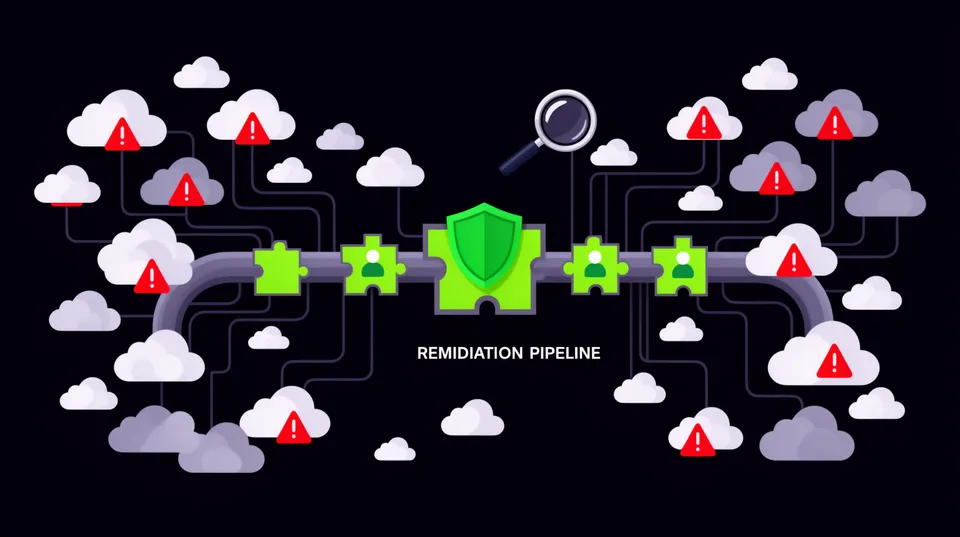
Automating vulnerability remediation with pre-validated playbooks significantly reduces MTTR and minimizes human error, ensuring fixes don't introduce new problems. Simply detecting a vulnerability isn't enough. The critical step is fixing it without breaking existing systems. Automated remediation means less manual intervention, faster response times, and a consistent application of security best practices. However, this automation must be production-safe. Automated remediation involves orchestrating specific actions to resolve a vulnerability. For instance, if a public S3 bucket is detected, a playbook could automatically apply a restrictive policy or disable public access settings. If an IAM role has excessive permissions, the playbook could attach a more granular policy. This is where Tamnoon excels, providing AI-powered remediation that generates precise fix-actions, often as code. These aren't just suggested actions. They're executable, verified steps. Remediation Playbooks within the Tamnoon platform are designed to handle common cloud security misconfigurations like S3 exposure, IAM over-permissioning, and unencrypted databases. They're built with a human-in-the-loop safety net, allowing experts to review and approve complex changes, particularly for critical production systems. This ensures that the remediation process is both fast and reliable, avoiding the operational disruptions that often plague manual fixes. Consider the challenge of rotating IAM access keys, a common remediation task. While necessary, if not handled carefully, it can cause application downtime. Tamnoon's playbooks address these complexities, providing mechanisms to manage dependencies and validate changes before full deployment. You can learn more about preventing issues during IAM key rotations in this article."Threat intelligence delivers evidence-based insights, including context and actionable advice, on existing or emerging threats to inform response strategies."Gartner
Prioritize Vulnerabilities Using Contextual Risk
Not all vulnerabilities are created equal, so prioritizing remediation efforts based on actual business risk and exploitability is essential to manage alert fatigue and optimize resource allocation. Organizations can't fix everything at once. With the security and vulnerability management market valued at $17.6 billion in 2025, it's clear the problem is large. Focusing on high-impact issues first ensures that the most critical threats are addressed. Contextual risk assessment factors in asset criticality, potential blast radius, and current threat intelligence. Cloud Security Posture Management (CSPM) tools like Palo Alto Cortex Cloud, Wiz, and Orca provide excellent visibility into security posture, generating a high volume of alerts. However, without proper prioritization, security teams face significant alert fatigue. A database with highly sensitive customer data exposed to the internet is a far greater risk than a development environment misconfiguration with no public access. Prioritization should consider factors like:- Asset Criticality: Is the affected resource hosting critical business data or applications?
- Exposure: Is the vulnerability publicly accessible, or does it require internal network access?
- Exploitability: Is there a known exploit for this vulnerability? (e.g., a CVE with high CVSS score and active exploitation reports).
- Data Sensitivity: What type of data is at risk? PII, financial data, or intellectual property?
Implement Continuous Monitoring and Feedback Loops
Continuous monitoring ensures that remediated vulnerabilities remain fixed and identifies new exposures quickly, while a robust feedback loop improves the effectiveness of remediation strategies over time. Cloud environments are. Resources are spun up and down constantly. A fix applied today might be undone by a misconfigured CI/CD pipeline or a new deployment tomorrow. Tools like AWS Security Hub, Azure Defender for Cloud, and SentinelOne Singularity provide continuous visibility into cloud resources and their security posture. Wazuh, for example, offers a vulnerability intelligence database that aggregates data from various sources, helping maintain up-to-date awareness. Establishing feedback loops between security and development teams is equally crucial. When a remediation is deployed, monitoring should confirm its effectiveness. If the same vulnerability reappears, or if a remediation causes an unexpected outage, that information needs to flow back to refine future playbooks and development practices. This continuous improvement cycle is a cornerstone of modern cloud security. CISA's Secure Cloud Business Applications (SCuBA) project provides guidance for federal agencies to secure their cloud environments, emphasizing ongoing vigilance and improvement, especially for hybrid identity solutions, as detailed in their advisories. This iterative process allows organizations to learn from each remediation, fine-tuning their automated playbooks and preventing recurrence. For instance, if an IAM policy fix consistently breaks an application, the feedback loop triggers an adjustment to the policy or a change in the application's required permissions.Foster Cross-Functional Collaboration
Breaking down silos between security and development teams is critical for successful vulnerability remediation, ensuring shared understanding, faster issue resolution, and mutual accountability. Security isn't solely the security team's responsibility. It's a shared effort across the organization. Disconnects between teams lead to delays, finger-pointing, and ultimately, increased risk. When security teams merely hand over a list of findings to DevOps, without context or remediation guidance, it creates friction and slows down the fixing process. True collaboration means security professionals understand development workflows, and developers understand security implications. Tools and platforms that integrate into existing DevOps toolchains, like those used for CI/CD, project management, and incident response, foster this collaboration. For example, when a security alert is generated by Wiz, Tamnoon can take that alert and automatically create a JIRA ticket for the responsible team, complete with a proposed remediation, potential impact analysis, and a pre-verified remediation script or IaC change. This transforms an abstract security finding into an actionable development task. This approach helps bridge the gap where DevSecOps collaboration can break remediation flows, ensuring everyone works from the same playbook. Such an integrated approach enables developers to fix issues themselves with provided, production-safe solutions, dramatically reducing the back-and-forth typically associated with remediation. It fosters a culture where security is a shared goal, not a hurdle. Ultimately, this collaboration helps avoid situations where 45% of data breaches occur in the cloud, often due to misconfigurations that could have been prevented or quickly remediated with better team .Standardize on Remediation Playbooks and Tooling
Establishing standardized remediation playbooks and consistent tooling provides a repeatable, efficient, and auditable process for addressing vulnerabilities across diverse cloud environments. Without standardization, every remediation becomes a bespoke project, leading to inconsistencies, increased errors, and higher operational overhead. Playbooks encapsulate the best practices for fixing common vulnerabilities, ensuring that remediation actions are consistent, safe, and effective. The OWASP Top 10, for example, identifies critical web application security risks and offers guidance on how to address them. resources like CISA's vulnerability analysis pathways can inform these playbooks. Standardized tooling means using a consistent set of security solutions for detection, analysis, and remediation across an organization's cloud footprint. This reduces the learning curve for security and operations teams and streamlines integration efforts. For instance, if an organization uses AWS and Azure, having a unified platform for remediation, like Tamnoon, allows them to apply consistent remediation logic regardless of the underlying cloud provider. This is critical for managing complex multi-cloud environments. These playbooks should be regularly reviewed and updated to reflect changes in threat landscapes, cloud provider services, and internal infrastructure. They become living documents, constantly improving. For example, if a KVM vulnerability, like CVE-2026-64561, allowing VM escapes, emerges, a playbook could be rapidly developed and deployed to mitigate it across affected virtual machines. Tamnoon's platform supports this by providing a library of Production-Safe Playbooks, which are essentially pre-packaged, verified automation scripts for common remediation tasks. These playbooks can be customized and extended, enabling organizations to codify their specific security policies and operational requirements into automated remediation workflows.Regularly Review and Update Security Policies
Periodically reviewing and updating security policies ensures they remain relevant and effective in an ever-changing cloud landscape, preventing outdated rules from creating new vulnerabilities. Cloud services, features, and configurations change frequently. What was a secure policy six months ago might not be sufficient today. Outdated policies can leave gaps that attackers exploit or generate false positives that contribute to alert fatigue. It's a fundamental aspect of maintaining a strong security posture. The OWASP Application Security Guide for CISOs emphasizes the need for continuous policy review. This involves a formal process for policy review, ideally on a quarterly or semi-annual basis, or whenever significant changes occur in the cloud environment or threat landscape. Policies should cover aspects such as:- IAM Roles and Permissions: Ensuring least privilege is consistently applied and old permissions are revoked.
- Network Security Groups (NSGs) and Firewalls: Verifying ingress/egress rules are strictly necessary.
- Data Encryption: Confirming data at rest and in transit are encrypted according to standards.
- Configuration Baselines: Validating that all resources adhere to defined secure configurations.

Tamnoon helps security teams remediate cloud risks faster with AI-augmented managed services — combining human expertise with automation so nothing falls through the cracks.
Learn more at tamnoon.ioFAQs
What is proactive vulnerability remediation in the context of cloud security?
Proactive vulnerability remediation in cloud security involves identifying and fixing security misconfigurations or weaknesses before they can be exploited. This goes beyond simple detection by integrating security into the development lifecycle (shift-left), automating fixes, and prioritizing remediation based on actual risk. It means not waiting for an incident to occur but actively eliminating potential attack vectors, often through Infrastructure as Code (IaC) security, automated playbooks, and continuous monitoring. The goal is to minimize the window of exposure and ensure business continuity by preventing breaches rather than just reacting to them.
How does Tamnoon's platform contribute to production-safe remediation?
Tamnoon's platform provides AI-powered remediation that generates specific, executable fix-actions for identified cloud vulnerabilities. It leverages battle-tested Remediation Playbooks designed to resolve issues without impacting application uptime. A crucial element is the human-in-the-loop validation, where Tamnoon's cloud experts review and approve complex or high-risk remediations to ensure zero downtime. This hybrid approach combines the speed of automation with the precision and safety of expert oversight, ensuring that fixes are not only fast but also production-safe.
Why is integrating security into IaC (shift-left) important for remediation?
Integrating security into Infrastructure as Code (IaC) is important for remediation because it allows detection and fixing of misconfigurations early in the development lifecycle, before they reach production environments. Remedying issues in code is significantly less costly and disruptive than correcting them on live infrastructure. By using tools to scan IaC templates, developers receive immediate feedback, enabling them to make changes proactively. This 'shift-left' approach prevents vulnerabilities from being deployed in the first place, drastically reducing the overall remediation burden and potential for production impact.
What does 'contextual risk' mean for vulnerability prioritization?
Contextual risk refers to prioritizing vulnerabilities based on their actual impact and exploitability within a specific business environment, rather than solely relying on generic severity scores. It involves factoring in asset criticality (e.g., is the affected resource hosting sensitive data?), exposure (is it publicly accessible?), and exploitability (is there a known, active exploit?). By understanding the business context, security teams can focus their remediation efforts on the vulnerabilities that pose the greatest risk to the organization, thus reducing alert fatigue and optimizing resource allocation.
How does cross-functional collaboration improve vulnerability remediation?
Cross-functional collaboration improves vulnerability remediation by breaking down silos between security and development teams, fostering a shared understanding and mutual accountability. When security findings are shared with context and proposed, production-safe fixes, developers can act quickly and efficiently. This reduces the friction and delays often seen with traditional hand-offs. Platforms like Tamnoon facilitate this by integrating with existing DevOps tools, automating the creation of actionable tasks with remediation instructions, and ensuring that security is an integrated part of the development and operations workflow, not an afterthought.