

Cloud security teams drown in alerts. Modern Cloud Native Application Protection Platforms (CNAPPs) like Wiz, Orca Security, and Palo Alto Networks Prisma Cloud excel at finding issues, but the sheer volume often paralyzes response. This isn't a problem with the CNAPPs themselves. It's a gap in translating detections into remediations at scale.
The operational reality is that identifying misconfigurations, vulnerabilities, and risky access patterns is just the first step. The true challenge lies in fixing them without disrupting production. Security teams are overwhelmed, and development teams are reluctant to deploy fixes they didn't originate, especially if those fixes lack clear context or validation.
This article addresses the fundamental problem of how to move beyond detection to effective, production-safe remediation. It explores the impact of alert fatigue, outlines strategies for prioritization, and details mechanisms for automated, expert-validated fix deployment.
The Production Impact of Unaddressed Alerts

A constant stream of security alerts, many of them low-priority or false positives, leads to alert fatigue. When security teams are constantly bombarded, their ability to discern critical threats from background noise diminishes. This desensitization can have severe production impacts, directly influencing availability, data integrity, and compliance posture.
Consider a misconfigured AWS S3 bucket. A CNAPP like Upwind or SentinelOne Singularity might flag it as publicly readable. If this alert is one of thousands, it might sit in a queue for days or weeks. During that time, sensitive data becomes accessible, potentially leading to a breach. The blast radius of such an incident includes not only reputational damage and regulatory fines but also direct operational disruption if a malicious actor exfiltrates or manipulates crucial application data. Recovering from such an event can involve significant engineering effort, forensic investigations, and emergency patch deployments that might impact system uptime.
According to Tamnoon's research, 53% of CNAPP detections remain open across 800 accounts observed in this study at the end of May 2026., 6.3% of those open CNAPP detections were connected to a Crown Jewel asset. These aren't just theoretical risks. They represent active exposures in production environments. An unaddressed alert on a critical asset is a ticking time bomb. When a New Microsoft Defender 0‑Day (CVE‑2026‑41091 and CVE‑2026‑45498) was actively exploited in the wild in 2026, organizations struggling with alert fatigue were slower to patch, increasing their window of vulnerability.
Prioritizing Remediation: Beyond Simple Severity Scores
Not all alerts are created equal, yet many CNAPP platforms present them as a flat list, or with only basic severity filtering. Effective remediation requires a nuanced approach to prioritization that goes beyond simple CVSS scores. Organizations need to understand an alert's context within their specific cloud environment, its potential impact on critical assets, and the exploitability of the vulnerability. This is where the concept of risk-based prioritization becomes crucial.
Identifying Crown Jewels and Business Context
The first step in intelligent prioritization is identifying your most critical assets, often called "crown jewels." These aren't just production databases or APIs. They include identity providers, key management systems, critical CI/CD pipelines, and data stores containing regulated or proprietary information. Tagging these resources in your cloud environment (e.g., using AWS tags, Azure tags, or GCP labels) allows security tools to apply a higher risk weighting to associated alerts. Tools like Cyera and Wiz often provide rich contextual data that can be used here.
An S3 bucket exposed to the internet is one thing. An S3 bucket exposed to the internet containing customer PII and backing a critical analytics service is another entirely. That business context elevates its priority. Cloudanix, for instance, uses risk scoring to prioritize security threats to minimize alert fatigue, which is a necessary step.
Understanding Exploitability and Attack Paths
A vulnerability or misconfiguration exists, but can it actually be exploited? Some CNAPPs, such as CrowdStrike Falcon® Cloud Security, incorporate adversary-informed risk prioritization. This means analyzing potential attack paths. For example, an overly permissive IAM role might only be exploitable if combined with another specific misconfiguration on an EC2 instance. Identifying these chained attack paths helps teams focus on the issues that present an immediate and direct threat, rather than theoretical ones. This reduces noise and ensures that remediation efforts target the most impactful exposures.
Tamnoon integrates with existing CNAPPs to pull in these critical insights. It then applies its own logic, often informed by remediation playbooks, to combine detection data with your defined business context and exploitability analysis. This creates a highly refined list of issues that demand immediate attention.
The Remediation Gap: Why Alerts Accumulate
Detection is only half the battle. The real problem isn't that CNAPPs generate too many alerts. It's that fixing those alerts is a multi-team, often manual, and error-prone process. Almost 90% of SOCs are overwhelmed by backlogs and false positives, and this directly feeds into the remediation gap. Edgescan's 2025 Vulnerability Statistics Report found that 45% of Enterprise vulnerabilities never get fixed. This statistic summarizes the problem perfectly: identified issues frequently remain unaddressed.
The Friction Between Security and DevOps
Security teams identify issues but often lack the permissions or expertise to fix them directly in production infrastructure. DevOps teams own the infrastructure, but they're focused on feature delivery and maintaining uptime. Security alerts often appear as additional, unplanned work, sometimes without clear instructions or guaranteed non-impact to services. This creates inherent friction.
Imagine a security finding for an over-permissive IAM role. The security team identifies it. They then create a ticket for the DevOps team. The DevOps team needs to investigate the role's actual usage, write a more restrictive policy, test it, and then deploy it. This entire cycle can take days or weeks, during which the over-permissioned role remains a vulnerability. Each hand-off, each manual review, introduces delays and opportunities for miscommunication.
Lack of Production-Safe Remediation Paths
Many security tools stop at identification because proposed remediations often carry a risk of breaking something. A suggested fix for an S3 bucket policy might inadvertently cut off a critical application's access. Disabling an unencrypted EBS volume might cause data loss if not handled carefully. Without a validated, production-safe remediation path, security teams hesitate to push for changes, and DevOps teams are rightly cautious about implementing them.
This is where platforms like Tamnoon shine. They convert identified risks into actionable, verified remediation playbooks. These aren't just generic scripts. They're atomic changes designed to address specific vulnerabilities safely. Tamnoon's AI-Powered Remediation engine analyzes the alert context, the affected resource, and its dependencies to propose the least disruptive and most effective fix.
Automated Remediation: Closing the Loop Safely
The only way to effectively tackle alert fatigue and eliminate the remediation backlog is through automation. This doesn't mean blindly auto-applying every fix. It means intelligent, context-aware automation with appropriate human oversight to ensure production safety.
Agentic Remediation for Precision Fixes
Traditional automation often relies on static rules that can be inflexible. Agentic remediation, however, uses AI to understand the context of an alert and generate specific, granular fix actions. Claude by Anthropic, for instance, scans codebases for vulnerabilities, validates findings to cut false positives, and suggests patches. This kind of intelligence is critical for moving beyond simple detection.
Tamnoon extends this by combining AI-Powered Remediation with expert human oversight. When a CNAPP like AWS Security Hub flags an issue, Tamnoon's platform processes it. It categorizes the alert, identifies the affected resource, checks for related dependencies, and then proposes a specific remediation. For example, if a publicly accessible database is detected, Tamnoon doesn't just block all external access. It can suggest tightening specific firewall rules or reassigning it to a private subnet, complete with the necessary Infrastructure-as-Code (IaC) or CLI commands.
Human-in-the-Loop Validation
For complex or high-impact remediations, full automation isn't always the answer. A human-in-the-loop approach ensures production safety. Tamnoon's platform allows security or DevOps engineers to review proposed remediations before they're applied. This might involve a simple approval click, or for more critical changes, a detailed review by Tamnoon's cloud experts. This collaborative model builds trust between security and development teams.
The process often looks like this:
- Detection: A tool like Wiz or Orca Security detects a misconfiguration (e.g., an EC2 instance with an overly permissive security group).
- Ingestion and Analysis: The alert is ingested into Tamnoon. AI analyzes the resource, its tags, associated applications, and network configuration.
- Remediation Proposal: Tamnoon generates a specific, production-safe fix, perhaps a refined security group ingress rule, along with the exact AWS CLI command or Terraform snippet.
- Review and Approval: The proposed fix is presented to the owning team (DevOps, SRE) or Tamnoon's experts for review. Context includes potential impact analysis and a rollback plan.
- Automated Execution: Upon approval, the fix is automatically applied. This could be via direct API calls, IaC pipeline integration, or a change management system.
- Verification: Tamnoon verifies that the fix was successful and the alert is resolved in the source CNAPP.
Remediation Playbooks for Common Issues
Many cloud security issues are recurring. IAM misconfigurations, S3 bucket exposures, unencrypted data stores, and insecure network configurations are common targets. Tamnoon provides Production-Safe Playbooks for these common threats. These are essentially pre-configured, battle-tested workflows that automatically apply the correct fix, often requiring little to no human intervention once approved.
For example, a playbook for an unencrypted EBS volume might automatically:
- Identify the unencrypted volume.
- Check if it's attached to a running instance.
- If attached, propose creating a snapshot, encrypting the snapshot, creating a new encrypted volume from the snapshot, and replacing the original volume (with an instance restart plan).
- If detached, propose encrypting the volume directly or deleting and recreating an encrypted one.
This significantly reduces the mean time to remediation (MTTR) because the fix isn't being devised from scratch every time. FortiCNAPP's AI Assistant, for instance, transforms SOC alert investigation with composite alerts, contextual timelines, and guided remediation, which helps streamline this process.
Integrating Remediation into Existing Workflows
Effective remediation doesn't replace existing tools. It integrates with them. No single tool solves every security problem. The goal is to create a cohesive ecosystem that leverages the strengths of each component.
Ecosystem Integration with Leading CNAPPs and Cloud Platforms
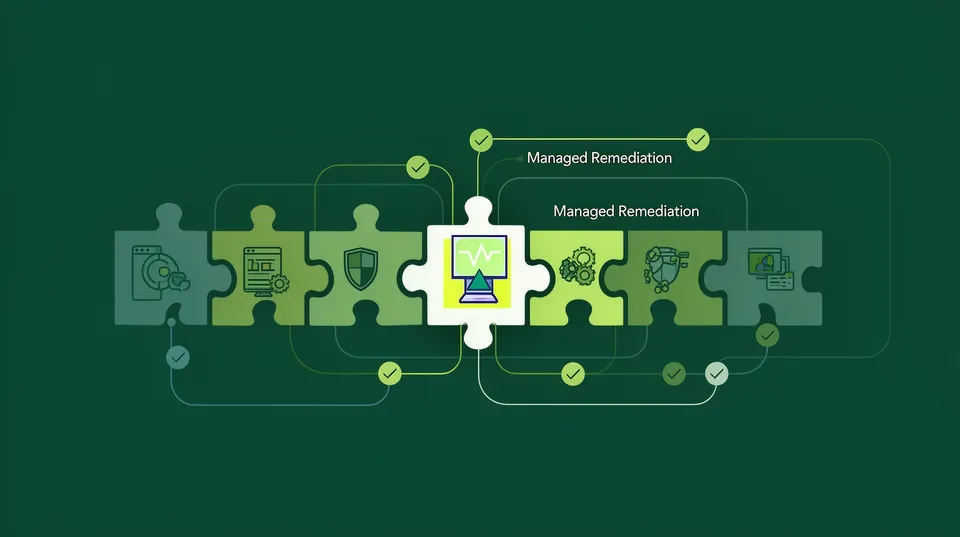
Tamnoon integrates with leading CNAPPs like Wiz, Orca Security, Prisma Cloud by Palo Alto Networks, and open-source tools. It also connects directly to cloud providers like AWS, Azure, and GCP. This Ecosystem Integration ensures that alerts flow from detection to remediation, without requiring security teams to manually transfer information or context.
When a new alert is generated by your existing CNAPP, Tamnoon can:
- Pull the alert data, including resource IDs, configurations, and associated metadata.
- Correlate it with other alerts or past remediation attempts.
- Generate a remediation proposal based on pre-defined playbooks or AI-driven analysis.
- Push remediation status updates back to the CNAPP or SIEM (e.g., Splunk, Microsoft Sentinel) to provide a unified view of security posture.
This creates a feedback loop that continually improves both detection and remediation efficiency. Organizations using security data lakes or platforms like AWS Security Hub benefit from this centralized approach, as it automates the "closing the loop" aspect.
Shifting Left with Remediation
While many remediations occur in production, the ideal is to prevent issues earlier. Integrating remediation capabilities into CI/CD pipelines can shift security left. If Tamnoon detects a misconfiguration in a development or staging environment, it can propose the fix then, allowing developers to incorporate it before it reaches production. This prevents cloud security misconfigurations from accumulating in the first place.
For example, if a Terraform template deploys an S3 bucket without server-side encryption, Tamnoon could:
- Detect this during a CI/CD scan or post-deployment validation in a non-production environment.
- Suggest a code modification to add the encryption block to the Terraform manifest.
- Optionally, create a pull request with the suggested change directly into the IaC repository, enabling developers to review and merge the secure code immediately.
This pre-emptive remediation is far more efficient and less disruptive than fixing issues in live production. Gomboc, for instance, offers deterministic automated remediation, which points to the maturation of this capability.
Measuring Success and Continuous Improvement
To demonstrate the value of a robust remediation strategy, teams need to measure its impact. Key metrics include mean time to detection (MTTD), mean time to remediation (MTTR), and the overall reduction in open security findings.
Mean Time to Remediation (MTTR)
A primary goal of automated remediation is to significantly reduce MTTR. By automating the analysis, proposal, and execution of fixes, the time from detection to resolution can drop from days or weeks to hours or even minutes. Tracking this metric over time provides tangible proof of improved security posture and operational efficiency. A shortened MTTR means the window of exposure for vulnerabilities is drastically reduced.
Reduction in Remediation Backlog
The ultimate goal is to eliminate, or at least substantially shrink, the remediation backlog. By systematically addressing alerts with automated playbooks and expert-validated AI-driven fixes, organizations can move toward a "zero open findings" state for many common issues. Regularly reporting on the number of open findings, their age, and their associated risk provides a clear picture of progress and areas that still need attention. You can find more detail on this topic in our article on shrinking your vulnerability backlog.
The CISO of 2028 needs more than just another dashboard showing vulnerabilities. They require a system that closes them. By focusing on production-safe remediation, organizations can turn a deluge of alerts into a streamlined process of continuous security improvement. Eliminate your remediation backlog by automating remediation with Tamnoon.

Tamnoon helps security teams remediate cloud risks faster with AI-augmented managed services — combining human expertise with automation so nothing falls through the cracks.
Learn more at tamnoon.ioFAQs
What is CNAPP alert fatigue and why is it a problem?
CNAPP alert fatigue occurs when security teams are overwhelmed by a high volume of security alerts generated by their Cloud Native Application Protection Platforms. While CNAPPs are excellent at detecting misconfigurations, vulnerabilities, and compliance violations, the sheer number of alerts often makes it impossible for human teams to address them all. This leads to critical alerts being missed, increased remediation backlogs, and a general desensitization to security warnings, directly impacting an organization's ability to maintain a strong security posture and respond effectively to real threats.
How does Tamnoon help reduce remediation backlogs?
Tamnoon addresses remediation backlogs by automating the entire remediation lifecycle from detection to fix. It integrates with existing CNAPPs to ingest alerts, prioritizes them based on business context and exploitability, uses AI-Powered Remediation to generate production-safe fix proposals, and offers a Human-in-the-Loop validation process for complex changes. This approach significantly speeds up the mean time to remediation (MTTR) and systematically clears the backlog, turning identified risks into actionable, validated solutions without requiring extensive manual effort from security or DevOps teams.
What does 'production-safe remediation' mean?
'Production-safe remediation' refers to the practice of fixing security vulnerabilities or misconfigurations in a live production environment without causing downtime, performance degradation, or unintended side effects to applications and services. This is achieved through careful analysis of the affected resources and their dependencies, generating precise and minimal changes, and often incorporating a validation step, either automated or human-in-the-loop, to ensure the fix is tested and verified before deployment. Tamnoon's Remediation Playbooks are designed with production safety as a core principle.
Can Tamnoon integrate with my existing cloud security tools?
Yes, Tamnoon is designed for extensive Ecosystem Integration. It connects with leading CNAPPs and cloud security platforms such as Wiz, Orca Security, Palo Alto Networks Prisma Cloud, AWS Security Hub, Azure Defender for Cloud, and Sentinel One Singularity, among others. This allows it to ingest alerts and vulnerability data from your existing security stack. Tamnoon then processes these alerts and orchestrates the remediation, pushing status updates back to your dashboards, ensuring that your existing investments in detection are amplified by efficient, automated remediation capabilities.
How does AI-Powered Remediation work with human oversight?
Tamnoon's AI-Powered Remediation engine analyzes incoming security alerts from CNAPPs, understanding the context of the misconfiguration or vulnerability, the affected resource, and its dependencies. It then generates specific, actionable remediation proposals, often in the form of IaC snippets or CLI commands. For routine or low-risk issues, these can be automated directly via Production-Safe Playbooks. For more complex or high-risk remediations, the system engages a Human-in-the-Loop. This means the proposed fix is presented to a security or DevOps engineer for review and approval, or validated by Tamnoon's cloud experts, ensuring that critical changes are vetted before deployment to prevent any unintended production impact.